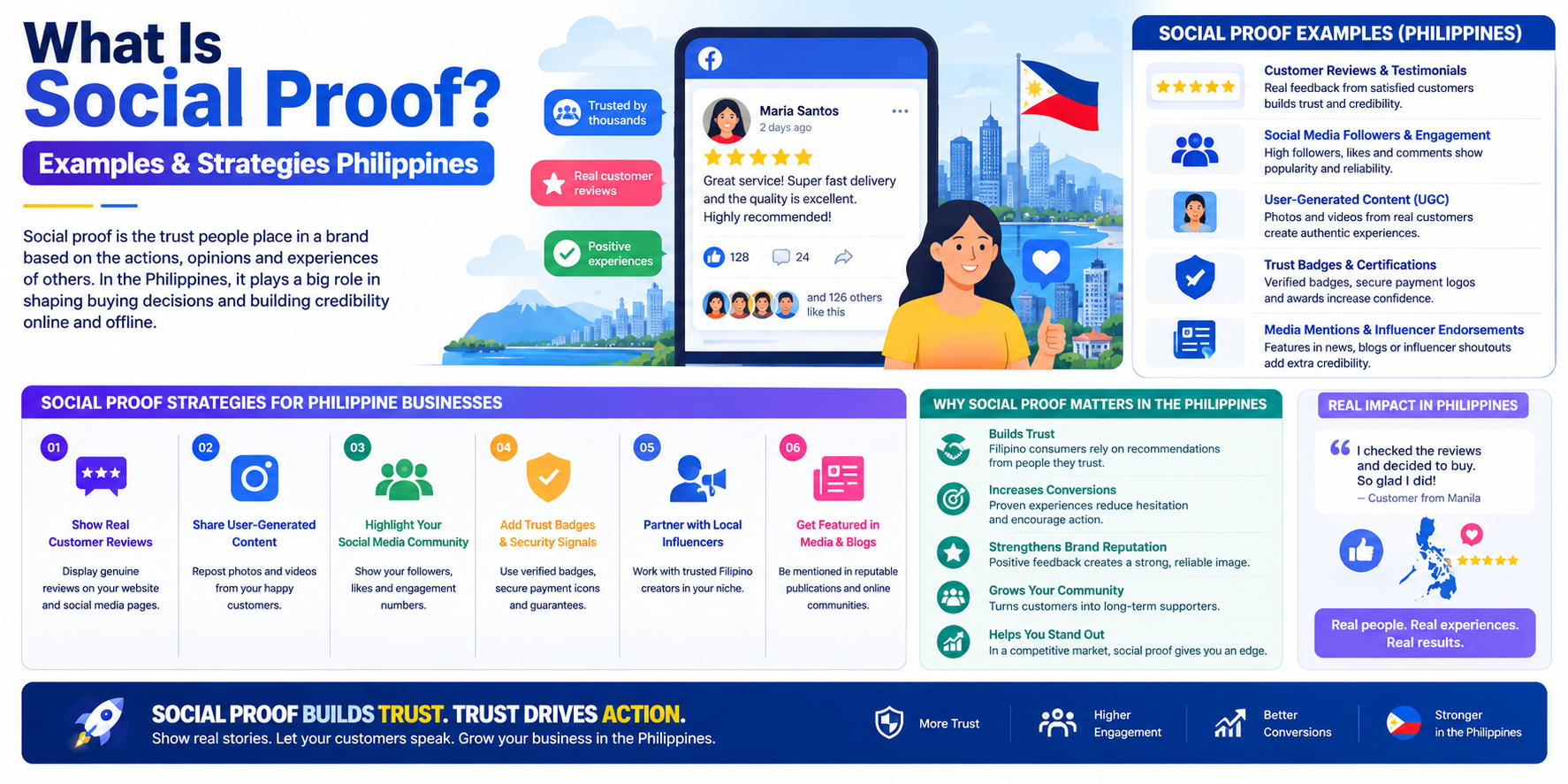
what is social proof : Examples and strategie philippine
You post a product on Facebook Marketplace. Decent photo, fair price, clear description. And the very first comment you get is... "Legit po ba?"
Every Filipino seller has read that comment. Probably a hundred times. Here's the thing though. That question isn't rude. It isn't even really about you. It's a buyer standing in the dark, asking whoever else happens to be nearby, "has anybody done this before me?" Answer that well and you've made a sale. Answer it badly, or worse, not at all... and they scroll away forever.
Quick answer: Social proof is the psychological phenomenon where people copy the choices of others when they feel unsure. In marketing it shows up as customer reviews, star ratings and reviews, customer testimonials, follower counts and "featured in" media logos. It works because customer trust transfers from strangers faster than it ever transfers from a brand talking about itself. That's the short version. Now let's actually dig in, because the Philippine market has some quirks that most articles on this topic completely skip.
Why This Matters More in the Philippines Than Almost Anywhere Else?
Filipinos are online. Really online. According to Meltwater's 2026 Philippine social media report, there are 95.8 million social media user identities in the country, roughly 81.9% of the population. Average time spent? Thirty-three hours and fifty minutes per week. That's basically a part-time job.
Philippine digital signals:
- Social media user identities: 95.8 million (81.9% of population) → Why it matters: Almost everyone can see your reviews
- Weekly social media time: 33 hours 50 minutes → Why it matters: Huge exposure window for social media mentions
- Facebook reach: 94.9% of internet users → Why it matters: One platform carries most peer recommendations
- TikTok reach: 82.2% of internet users → Why it matters: Where user-generated content now spreads fastest
- Shopee + Lazada + TikTok Shop GMV: USD 22 billion (FY2025) → Why it matters: Ratings decide who wins that money
- Shopee orders per shopper per year: About 11 → Why it matters: Repeat buying rewards brand reputation
Sources: Meltwater, Cube Asia.
Anyway. Numbers are nice but they miss the emotional part. A lot of Filipino buyers pay cash on delivery specifically because they don't fully trust online sellers yet. That hesitation is the gap. And online social proof is what fills it. Which platform you focus on changes the shape of that proof, too. Our breakdown of the importance of social media for business growth in the Philippines goes deeper on that side of it. Here we're staying on the trust question.
What Is Social Proof in Marketing?
Think about the two carinderias on the same street. One is packed at noon, plates clattering, people waiting. The other is empty, same menu, same prices. Which one do you walk into? You already know. Nobody checked the food quality. The crowd did the thinking for you. That's the whole idea, compressed into one lunch break.
In business terms, social proof means showing evidence that other people already chose you and were happy about it. That evidence can be loud, like a viral TikTok, or quiet, like a small "4.8 stars from 1,204 buyers" line under a price. Both send the same message. Both reduce fear. And reducing fear is honestly most of what selling online actually is.
Social Proof Definition and Meaning:
The term comes from psychologist Robert Cialdini, who introduced it in his 1984 book Influence: The Psychology of Persuasion. His definition, simplified: when we're unsure, we look at what similar people did and copy it. That's it. Marketing psychology rarely gets simpler than this.
Why Social Proof Matters for Businesses?:
Filipino shoppers face real risk. Fake sellers, wrong sizes, items that never arrive. So credibility signals do heavy lifting here. A visible wall of positive reviews tells a nervous buyer that somebody already took the risk and survived. That single reassurance often decides the sale.
How Social Proof Influences Customer Decisions?:
Buying is mostly guessing. Will this fit? Will it last? Consumer behavior research shows people shortcut that guessing by borrowing other people's conclusions. So purchase decisions stop being about your product claims. They become about whether strangers who look like the buyer said yes.
Social Proof vs. Traditional Advertising:
- Who's speaking: Traditional advertising → You → Proof from real customers → Someone with nothing to gain
- Trust level: Traditional advertising → Low and falling → Proof from real customers → Higher, though not automatic
- Cost pattern: Traditional advertising → Pay per impression, forever → Proof from real customers → Collect once, display for years
- Control: Traditional advertising → Total → Proof from real customers → Partial, which is exactly why it's believable
- Shelf life: Traditional advertising → Ends when budget ends → Proof from real customers → Compounds over time
- Best use: Traditional advertising → Reach and awareness → Proof from real customers → Conversion optimization
Worth knowing: Nielsen's long-running trust research found 88% of consumers trust recommendations from people they know above every paid format. Ads still matter. They just work better with proof stapled to them.
How Does Social Proof Work?
The mechanism has two ingredients and both have to be present. First, uncertainty. If a buyer already knows exactly what they want, other people's opinions barely register. Second, similarity. A review from someone who sounds like the buyer, shops like the buyer, earns like the buyer, hits far harder than a review from a stranger in a completely different situation.
Mix those two and imitation kicks in almost automatically. That's why "1,000 Filipino moms bought this" outperforms "1,000,000 customers worldwide" for a Philippine audience. Smaller number. Closer match. Stronger pull. Social proof psychology is less about volume than most people assume.
Why People Trust Other Customers?:
Simple logic, really. A customer gains nothing by lying. A brand gains everything. So buyers weight the two sources differently without even thinking about it. Add verification badge markers like "Verified Purchase" and the effect strengthens, because now the reviewer's stake is provable.
The Psychology Behind Social Proof — three forces stack here:
- Conformity — documented in Solomon Asch's classic line-judgment experiments
- The halo effect — where one good signal colours everything else
- The wisdom of the crowd — our instinct that many people can't all be wrong Together they form a shortcut the brain genuinely prefers.
How Social Proof Builds Trust and Credibility?:
Brand credibility grows through specifics, not adjectives. "Great service" convinces nobody. "Ordered Tuesday, arrived in Cebu Thursday, seller replied within ten minutes" convinces almost everybody. Detail is what separates believable trust signals from filler. Name the city. Name the timeline. Name the problem solved. Vague social proof is barely proof at all.
How Social Proof Can Increase Conversions?:
The numbers here are unusually strong. Research from Northwestern University's Spiegel Research Center found purchase likelihood rises 270% once a product carries five reviews instead of none. Higher-priced items gained 380%. That's social proof conversion working at full strength.
What was tested, measured effect, and source?:
- Product with 5 reviews vs zero: +270% purchase likelihood → Source: Spiegel Research Center
- Reviews on lower-priced items: +190% conversion → Source: Spiegel Research Center
- Reviews on higher-priced items: +380% conversion → Source: Spiegel Research Center
- "Verified buyer" badge shown: +15% odds of purchase → Source: Spiegel Research Center
- User-generated content on page: +29% web conversion → Source: AMRA & ELMA industry data
- Video customer testimonials: Up to +80% conversion lift → Source: DVI Group
One caution before you get too excited. A 2026 review of BrightLocal's Local Consumer Review Survey shows trust in reviews has slid hard, from 79% in 2020 down to 42% in 2025. Buyers got burned by fakes. So volume alone stopped being enough. Authenticity is now the scarce resource, which means the way you collect social proof matters more than how much of it you pile up.
What Are the 6 Types of Social Proof?
Not all social proof is created equal. A dermatologist vouching for a serum lands differently than your tita vouching for it and both land differently than a Shopee badge. Knowing the types of social proof lets you pick the right tool instead of throwing everything at the wall and hoping.Cialdini's framework, as marketers use it today, breaks into six buckets. Most Philippine businesses only lean on one or two. That's usually the whole problem, actually. Expert social proof covers licensed authority. Celebrity social proof borrows fame. User social proof comes from ordinary buyers leaving reviews and ratings. And certification social proof is the paperwork that says you're real.
The six types — what each looks like, best for, and Philippine execution:
- Expert: What it looks like → Licensed professional endorses you → Best for → High-risk, technical purchases → Philippine execution → Dermatologist, PRC-licensed engineer, registered dietitian
- Celebrity: What it looks like → Famous person uses your product → Best for → Awareness at scale → Philippine execution → Kapamilya or Kapuso talent, PBA player, big vlogger
- User: What it looks like → Ordinary buyers say it worked → Best for → Everyday products → Philippine execution → Shopee reviews, TikTok unboxing, Facebook comments
- Wisdom of the crowd: What it looks like → Big numbers of people chose you → Best for → Reducing hesitation → Philippine execution → "18,400 orders shipped nationwide"
- Wisdom of friends: What it looks like → Someone you know recommends it → Best for → Highest conversion → Philippine execution → Viber group chat, barkada referral, Messenger forward
- Certification: What it looks like → A trusted body approves you → Best for → Legitimacy concerns → Philippine execution → DTI registration, SEC papers, Preferred Seller badge
Expert Social Proof:
This is authority borrowed on purpose. A licensed professional's opinion outranks a hundred anonymous stars when stakes are high. Skincare, supplements, financial products, construction materials. Get real expert recommendations on record, with the credential visible, then place that quote near the price.
Celebrity and Influencer Social Proof:
Filipinos follow creators heavily. Industry data shows 86% of Filipino users follow at least one influencer and 70% of digital buyers have purchased because of one. Celebrity endorsements still work here in a way they've faded elsewhere. Budget accordingly, though.
Influencer tier breakdown — follower range and typical rate per post:
- Nano: 1,000–10,000 followers → Around ₱5,000 per post
- Micro: 10,000–50,000 followers → Around ₱40,000 per post
- Macro: 100,000–1 million followers → Around ₱80,000 per post
- Mega: 1 million+ followers → Around ₱150,000 per post
Rates via INSG's Philippine influencer marketing report. Notice something? Micro-influencers cost a fraction of mega talent and usually convert better, because their audience actually knows them.
Customer Reviews and Testimonials:
This is the workhorse. Customer reviews are cheap, scalable and endlessly reusable. One weird finding worth memorising: Spiegel's research found purchase likelihood peaks between 4.0 and 4.7 stars, then drops as ratings approach a perfect 5.0. Too perfect reads as fake.
User-Generated Content (UGC):
UGC is content your customers make without being paid. Unboxing clips, haul videos, "sulit ba?" reaction posts. Philippine market data suggests UGC drives roughly 6.9 times more engagement than brand-produced content, plus about 28% lower cost per acquisition. Free marketing that outperforms paid marketing.
Certifications, Awards, and Media Mentions:
Third-party stamps close the legitimacy gap fast. Display your DTI or SEC registration, any certifications you hold, industry awards, and media mentions from recognisable outlets. For a new seller with no reviews yet, this category is often the only proof available. Use it.
Referral and Peer Social Proof:
The strongest form, full stop. When a suki tells her group chat about you, that recommendation carries more weight than any ad you could buy. Word-of-mouth marketing in the Philippines runs on Messenger, Viber and actual barangay conversation. Make sharing easy and it compounds quietly.
18 Social Proof Examples for Your Marketing
Right, the practical part. Treat what follows as a menu, not a to-do list. Nobody runs all eighteen. Pick four or five that match your business, do them properly, then add more later once those are humming. Good social proof beats plentiful social proof, always. I've ordered these roughly by how fast they pay off. The early ones you could ship this week with no budget. The later ones need more setup but tend to keep giving. These social proof marketing examples all work in the Philippine context specifically, not just in theory.
One more note before diving in. The social proof tactics below are deliberately low-tech. You don't need expensive software for any of them. Most of these social proof techniques run on a spreadsheet, a phone camera and the willingness to actually ask people for feedback.
1. Display Customer Reviews on Your Website:
Put reviews where the decision happens, meaning on the product page itself, not buried on a separate testimonials tab nobody visits. Show the star average, the review count and at least three full-text reviews. Include the customer's city. "Maria, Davao" beats "Maria, verified buyer" every time.
2. Add Customer Testimonials to Landing Pages:
Every landing page needs proof directly beside its call to action. Not above the fold only. Beside the button. Pull one strong quote that answers the exact objection that page addresses. If the page sells speed, the testimonial should mention delivery time. Match the message.
3. Showcase User-Generated Content:
Create a branded hashtag and ask buyers to post with it. Then repost the good stuff, with permission. A gallery of real Filipino customers holding your product beats studio photography for believability. Bonus, it costs nothing and gives you infinite content for your social media marketing calendar.
4. Share Customer Success Stories:
Longer than a testimonial, shorter than a case study. Structure it as before, during, after. "Nanay Cristy sold 12 pieces a week. Now she sells 90." Customer stories work because readers see themselves in the starting point, not the ending. Keep the numbers honest and specific.
5. Highlight Expert Recommendations:
Find one credible professional in your category and formalise the relationship. A quote, a short video, a co-authored guide. Display their credentials clearly beside their words. For regulated categories this also strengthens your brand credibility with platforms, not just with buyers.
6. Partner With Relevant Influencers:
Relevance beats reach. A 12,000-follower Cebu food creator will outsell a 2-million-follower national celebrity for a Cebu restaurant. Every time. If you're building creator partnerships from scratch, our guide to social media marketing agency services in the Philippines covers how local brands usually structure these. Vet engagement rate, not follower count, then check whether comments look like real conversation or bot filler. Cheap influencer marketing done right compounds.
7. Build a Brand Ambassador Program:
Turn your best repeat buyers into brand ambassadors. Give them a code, a small commission and early access to launches. Resellers already operate this way across the Philippines so the model feels natural here. Twenty committed ambassadors typically outperform one expensive endorser.
8. Showcase Ratings and Review Scores:
Aggregate scores scan faster than paragraphs. Display "4.6 out of 5, based on 2,318 reviews" prominently. Then let people click through to read the detail. Remember the sweet spot though. A 4.6 with visible mixed feedback converts better than a suspiciously flawless 5.0.
9. Display Your Number of Customers:
Counters work because they trigger the crowd instinct. "Trusted by 8,400 Filipino businesses" or "31,092 orders delivered nationwide." Keep it accurate and update it. If your number is small, get specific instead. "Every one of our first 200 customers reordered" is a stronger claim anyway.
10. Share Business Milestones:
Anniversaries, order counts, new branches, awards. Milestone posts give you a legitimate reason to talk about your own success without sounding boastful, because you're celebrating rather than selling. These also generate social media engagement spikes, which feeds back into visibility.
11. Highlight Awards and Certifications:
Badge row in the footer, plus one near checkout. DTI business name registration, BIR registration, any industry accreditation, safety certifications, marketplace seller tiers. In a market where buyers actively worry about scams, paperwork becomes persuasion. Odd but true.
12. Show "Featured In" Media Logos:
Been mentioned by Rappler, ABS-CBN, Inquirer, Manila Bulletin or a respected niche publication? Show the logos. Even a local news feature carries weight. Link each logo to the actual article so it's verifiable, because unverifiable logos now read as suspicious to savvy buyers.
13. Use Social Proof in Advertising:
Put reviews inside your ad creative. A Meta ad showing a real five-star comment outperforms a polished product shot for most Philippine advertisers. Screenshot format works well, weirdly. Social media advertising costs drop when the creative already answers the trust question before the click.
14. Add Social Proof to Your Checkout Page:
Checkout is where doubt spikes and carts die. Add a short testimonial about delivery reliability, plus payment security badges, right beside the confirm button. Mention your return policy in one line. For COD-heavy audiences, reassurance here matters more than anywhere else on the site.
15. Use Referral and Word-of-Mouth Marketing:
Build a referral loop with a real incentive. GCash credit, a discount code, free shipping on the next order. Then make sharing one tap. Filipino buying culture already runs on referrals so you're not creating behaviour, you're just making existing behaviour trackable.
16. Feature Customer Mentions on Social Media:
Screenshot the good DMs and comments, then post them. With permission, obviously. This turns scattered social media mentions into a running archive of customer experience proof. Weekly cadence works well. Nothing fancy needed, just consistency and it fills content gaps painlessly.
17. Create Limited-Time Social Proof Campaigns:
Time your pushes with Philippine buying rhythms. Payday weeks around the 15th and 30th, plus 9.9, 10.10, 11.11 and 12.12. Shopee's Q4 alone accounts for about 31% of its annual GMV. A social proof campaign built around "1,200 sold in 48 hours" hits hardest during those windows.
18. Show Social Engagement and Community Size:
Your social media followers, group members and community size are proof in themselves. A Facebook group with 14,000 active members signals staying power that no ad can fake. Creators working on this specific problem may find our Instagram follower growth guide useful. This is where deliberate growth work pays off and it's exactly what a service like BoostingPH exists to support.
Tactic comparison — effort, speed of payoff, and best for:
- Website reviews: Effort → Low → Speed of payoff → Fast → Best for → Every business
- Checkout proof: Effort → Low → Speed of payoff → Fast → Best for → Ecommerce
- UGC hashtag: Effort → Medium → Speed of payoff → Medium → Best for → Consumer brands
- Micro-influencers: Effort → Medium → Speed of payoff → Medium → Best for → Beauty, food, fashion
- Ambassador program: Effort → High → Speed of payoff → Slow → Best for → Reseller models
- Case studies: Effort → High → Speed of payoff → Slow → Best for → B2B and services
How to Collect Social Proof for Your Business?
Most businesses don't have a social proof problem. They have a collection problem. Happy customers exist. They just never got asked so the good feeling evaporated in a day and nobody wrote anything down. Timing is nearly everything here. Ask too early and the customer hasn't experienced the value yet. Ask too late and the emotion has cooled. The window below is where customer feedback actually converts into usable material and it's narrower than people expect.
Business type — best moment to ask, and channel that works in PH:
- Ecommerce product: Best moment → 3–5 days after delivery → Channel → Messenger or SMS follow-up
- Food and beverage: Best moment → Same day, right after service → Channel → QR code on the receipt
- Service business: Best moment → Right after a visible win → Channel → Personal message from the owner
- Subscription or SaaS: Best moment → After the first success moment → Channel → In-app prompt plus email
- Reseller or distributor: Best moment → After their second reorder → Channel → Direct call, then written follow-up
Ask Customers for Reviews and Testimonials:
Make it embarrassingly easy. One link, one screen, three questions maximum. Ask what problem they had, what changed and what they'd tell a friend. Those three answers produce publishable customer testimonials without any editing. And always ask by name, never through a generic blast.
Create a User-Generated Content Strategy:
Give people a reason and a format. Run a monthly photo contest, offer a discount for tagged posts, or feature one customer weekly on your page. Structure beats hope. A documented user-generated content plan produces steady material instead of occasional lucky posts.
Encourage Customers to Share Their Experiences:
Include a small card in every package asking for a post. Add the hashtag. Reply to every single tagged mention within a day, because visible responsiveness encourages more sharing. Community engagement is a loop, not a broadcast and the loop only spins if you keep answering.
Work With Experts and Influencers:
Start with product seeding before paid deals. Send samples to twenty micro-influencers in your niche with zero obligation attached. Choosing the right platform first helps, and our social media services guide for Philippine businesses walks through that decision. Some will post, some won't. The ones who do generate authentic content you can then license for ads, which stretches the budget considerably.
Turn Customer Feedback Into Case Studies:
Pick your three best outcomes and write them up properly. Situation, obstacle, action, result, with real numbers. Case studies convert cautious B2B buyers better than any other format. One good one, updated yearly, can carry an entire sales page for years.
Where Should You Use Social Proof?
Placement is a bigger lever than volume. A single testimonial sitting beside a buy button outperforms twenty testimonials parked on a page nobody clicks. Proximity to the decision, that's the rule for social proof. Think about where hesitation actually happens in your funnel. Then put the reassurance right there. Social proof for ecommerce follows a slightly different map than proof for service businesses, though the logic is identical. Below is the placement order most Philippine sellers should work through.
Location — proof to use, and expected impact:
- Product page: Proof → Star average plus 3 full reviews → Expected impact → High
- Checkout: Proof → Delivery testimonial plus payment badges → Expected impact → Very high
- Landing page hero: Proof → One quote answering the main objection → Expected impact → High
- Homepage: Proof → Logo strip plus customer counter → Expected impact → Medium
- Email: Proof → Review snippet inside the offer → Expected impact → Medium
- Paid ads: Proof → Screenshot of a real comment → Expected impact → High
- Social bio: Proof → Follower count plus awards → Expected impact → Medium
Social Proof on Your Website:
Spread it, don't stack it. Homepage gets counters and logos. Category pages get aggregate ratings. Product pages get full reviews with photos. Social proof for websites works best when each page carries the specific evidence that page's visitors need, rather than one big wall of praise.
Social Proof on Landing Pages:
A landing page has one job so its proof must be equally focused. Choose testimonials that mirror the exact promise in your headline. If the page promises fast results, the quote should mention speed. Mismatched praise actively lowers conversion rate.
Social Proof in Social Media Marketing:
Reshare customer content weekly. Pin your best review to the top of your page. Screenshot glowing comments into carousel posts. Social media social proof compounds because each reshare exposes your evidence to that customer's network too. Free reach you didn't pay for. Treat social media proof as a permanent content pillar, not an occasional post.
Social Proof in Email Marketing:
Drop a short review directly into promotional emails, right above the button. Abandoned-cart emails especially benefit, since the reader already hesitated once. Industry data suggests review snippets can lift click-through by around 25%. Small change, decent return.
Social Proof in Paid Advertising:
Ad fatigue is real and expensive. Rotating customer social proof into creative keeps performance stable longer, because each new customer voice feels fresh even when the offer hasn't changed. For the broader paid and organic mix, see our SMM in the Philippines overview. Test comment screenshots against polished graphics. In the Philippines, the messy screenshot usually wins.
Social Proof During the Checkout Process:
This is the highest-leverage placement on your entire site. Add one delivery-focused testimonial, visible payment security marks, and a plain-language return policy. Cash-on-delivery shoppers in particular need to see that other people received their orders intact before they'll commit.
How to Use Social Proof Across the Customer Journey?
Different stages need different social proof. A stranger who's never heard of you needs volume and visibility. Someone comparing three options needs detail and specificity. Someone with their finger over the buy button needs reassurance about risk. Same tool, three different jobs. Mapping proof to stage is what separates a coherent social proof strategy from random testimonial placement. Here's how the customer journey breaks down for a typical Philippine brand.
Stage — buyer's question, and proof that answers it:
- Awareness: Buyer's question → "Who are these people?" → Proof that answers it → Follower counts, media logos, viral UGC
- Consideration: Buyer's question → "Is this right for me?" → Proof that answers it → Detailed reviews, comparisons, success stories
- Conversion: Buyer's question → "Will I regret this?" → Proof that answers it → Star ratings, guarantees, delivery testimonials
- Retention: Buyer's question → "Did I choose well?" → Proof that answers it → Community access, customer features, loyalty perks
Social Proof for Awareness:
At this stage you're proving you exist and that others noticed. Big numbers help. Follower counts, view counts, "as seen on" mentions. Viral user-generated content does the heaviest lifting here, since discovery in the Philippines increasingly happens on TikTok rather than Google.
Social Proof for Consideration:
Now the buyer is comparing. They need depth, not volume. Long reviews mentioning specific use cases, comparison content, and expert recommendations that address technical doubts. This is where a well-written case study earns its keep, especially for higher-priced purchases.
Social Proof for Conversion:
Risk reduction, purely. Star ratings near the price, a delivery testimonial at checkout, a visible guarantee, and payment trust signals. Every element here should answer one silent question: what happens if this goes wrong? Answer it clearly and buying decisions get easier.
Social Proof for Customer Retention:
Proof keeps working after the sale. Feature existing customers publicly, run a members-only group, celebrate their wins. This reinforces that they chose correctly, which reduces buyer's remorse and quietly builds the customer base that generates your next wave of referrals.
How to Measure the Effectiveness of Social Proof?
If you can't measure it, you're just decorating. And plenty of businesses do exactly that, plastering social proof everywhere without ever checking whether any of it moved a number. The trick is isolating one variable at a time. Change the checkout testimonial, leave everything else alone, then compare a full two weeks against the previous two weeks. Messy, imperfect, still far better than guessing. Proper social proof tools make this easier but a spreadsheet works fine at first.
Metric — how to calculate it, healthy direction:
- Conversion rate: How to calculate → Orders ÷ sessions × 100 → Healthy direction → Up 10–30% after proof added
- Review velocity: How to calculate → New reviews ÷ orders × 100 → Healthy direction → 5–15% of buyers reviewing
- Average rating: How to calculate → Total stars ÷ review count → Healthy direction → Hold 4.3–4.8
- UGC engagement: How to calculate → Engagements ÷ reach × 100 → Healthy direction → Above brand-content baseline
- Referral share: How to calculate → Referred orders ÷ total orders → Healthy direction → Growing quarter over quarter
- Cart abandonment: How to calculate → Abandoned ÷ initiated carts → Healthy direction → Falling after checkout proof
Track Conversion Rates:
Set a clean baseline before you change anything. Two weeks minimum. Then add your proof element and measure the same window afterward. Segment by device too, because mobile behaviour in the Philippines differs sharply from desktop. Most of your traffic is mobile anyway.
Monitor Review and Rating Growth:
Count new reviews monthly and divide by orders shipped. That ratio tells you whether your collection process actually works. If fewer than 5% of buyers leave feedback, your ask is broken somewhere. Fix the timing or the friction before blaming customers.
Measure Engagement With UGC:
Compare engagement rate on customer-made posts against your own branded posts. If UGC isn't outperforming, your reposting choices need work. Track saves and shares specifically, since those signal genuine interest far better than likes do in current platform algorithms.
Compare Landing Page Performance:
Run one page with testimonials against an identical page without them. Same traffic source, same period. This is the cleanest read on marketing effectiveness you can get without expensive tooling. Free A/B tools handle this fine for most Philippine small businesses.
Track Referral and Customer Acquisition Rates:
Give every ambassador and referral source a unique code. Then measure what share of monthly orders arrives through those codes. Rising referral share means your brand reputation is compounding. Falling share usually means your post-purchase experience slipped somewhere.
Common Social Proof Mistakes to Avoid
Some social proof mistakes are just wasteful. Others are actually illegal in the Philippines now, which surprises a lot of sellers. Since Republic Act No. 11967, the Internet Transactions Act of 2023, online merchants are legally required to make honest representations about their goods and services. The law created an Electronic Commerce Bureau under the DTI with real enforcement powers. Fabricated reviews sit squarely in deceptive-practice territory. Don't risk it.
Using Fake Reviews or Testimonials:
Beyond the legal exposure, fakes stopped working. BrightLocal's 2025 data shows 46% of consumers are already suspicious of AI-written review text. Buyers spot generic praise instantly. One invented testimonial can undo years of accumulated customer trust and recovery takes far longer than the shortcut saved.
Showing Irrelevant Testimonials:
A glowing quote from a Manila corporate client means little to a Cebu-based sari-sari owner. Mismatched proof creates distance instead of closing it. Segment your testimonials by customer type and show each visitor the ones featuring people like them.
Using Too Much Social Proof:
Twelve badges, four counters and a scrolling testimonial ticker all at once reads as desperate. Cluttered pages also slow down, which hurts mobile conversion. Three strong credibility signals placed thoughtfully beat fifteen crammed together. Restraint signals confidence.
Choosing Influencers Without Relevant Audiences:
Follower count lies. Check engagement rate, comment quality and audience location before paying anyone. Also confirm they disclose properly. Under the Ad Standards Council's April 2024 Code revision, paid relationships must be labelled visibly, not buried below the fold in a caption.
Failing to Keep Reviews Authentic and Current:
Testimonials dated 2021 tell visitors your best days are behind you. Refresh quarterly. Rotate in recent positive reviews, retire old ones, and never edit a customer's words beyond fixing a typo. Authenticity is fragile, and once it breaks, nothing else on the page gets believed.
Social Proof Best Practices
Everything above condenses into five habits. Follow these and you'll avoid most of what goes wrong. Ignore them and even a large pile of social proof will underperform. None of this requires budget, by the way. It requires attention, which is arguably harder. These social proof best practices apply whether you're running a Shopee store from your bedroom or managing a national brand. Build a written social proof strategy for marketing and the habits stop depending on whoever happens to remember them.
Practice — what to actually do, and frequency:
- Specificity: What to actually do → Include names, cities, numbers, timelines → Frequency → Every testimonial
- Placement: What to actually do → Position proof beside conversion points → Frequency → Review quarterly
- Variety: What to actually do → Mix expert, user, crowd and certification types → Frequency → Ongoing
- Freshness: What to actually do → Rotate in reviews from the last 90 days → Frequency → Quarterly
- Testing: What to actually do → Change one element, measure, keep winners → Frequency → Monthly
Use Specific and Authentic Customer Feedback:
"Sobrang bilis ng delivery, two days lang from Manila to Bacolod" beats "great service" by a mile. Specificity proves a real person wrote it. Never sanitise customer language into corporate English either, because the rough edges are precisely what makes it believable.
Put Relevant Proof Near Conversion Points:
Map every place a visitor must decide something. Add to cart, checkout, sign up, book a call. Then place matching evidence within eyeline of each one. Conversion optimization is mostly this, repeated patiently across every page that matters.
Use Different Types of Social Proof:
Layer your evidence. Pair a verification badge with real reviews and one expert quote. Different buyers respond to different signals so covering multiple types of social proof widens your net without adding clutter, provided you keep each element small.
Keep Your Social Proof Up to Date:
Set a calendar reminder every quarter. Pull fresh customer feedback, update your counters, remove anything stale. A store showing "4.9 stars, 47 reviews, last updated 2023" reads as abandoned. Currency is itself a trust signal, quietly.
Test Different Formats and Placements:
Video versus text. Carousel versus static wall. Above the fold versus beside the button. Test one change at a time and record results somewhere permanent. What works for a Philippine beauty brand often fails for a B2B service so borrow ideas, verify locally.
Putting It All Together: A 90-Day Plan
Reading about social proof is easy. Shipping it is the hard part. So here's a realistic sequence for a small Philippine business starting from nothing.
Days — focus, and concrete output:
- 1–15: Focus → Collection → Concrete output → Set up a review request flow, ask your last 50 buyers
- 16–30: Focus → Foundation → Concrete output → Add reviews to product pages and checkout
- 31–45: Focus → Content → Concrete output → Launch a branded hashtag, repost customer photos weekly
- 46–60: Focus → Amplification → Concrete output → Seed 20 micro-influencers, build a logo strip
- 61–75: Focus → Community → Concrete output → Start a customer group, feature buyers publicly
- 76–90: Focus → Measurement → Concrete output → Compare metrics against your day-one baseline
If you're also working on the visibility side of this, our guides on social media marketing strategy and the best social media platforms in the Philippines pair naturally with everything covered here. Growing an audience and proving your credibility are two halves of the same job, really.
Frequently Asked Questions About Social Proof
What is an example of social proof?
A Shopee product page showing "4.7 stars from 3,210 buyers" alongside photo reviews from real customers. Other everyday examples include TikTok unboxing videos, "featured in Rappler" logos, follower counts and a friend recommending a seller in your Viber group chat.
Why is social proof important in marketing?
Because buyers trust other buyers more than they trust brands. It reduces perceived risk at the exact moment someone hesitates. In the Philippines, where scam fear and cash-on-delivery caution run high, visible evidence from previous customers often decides whether a sale happens at all.
What are the 6 types of social proof?
Expert, celebrity, user, wisdom of the crowd, wisdom of friends and certification. Expert means licensed professionals. Celebrity means famous endorsers. User means ordinary customers. Crowd means large numbers. Friends means personal recommendations. Certification means official badges, awards and registrations from recognised bodies.
How does social proof increase sales?
It removes doubt. Northwestern's Spiegel Research Center found products with five reviews are 270% more likely to be purchased than products with none, rising to 380% for higher-priced items. Displaying a verified-buyer badge alone improved purchase odds by roughly 15%.
How do you get social proof for a new business?
Start with what you have. Show your DTI registration, any certifications, and your professional credentials. Offer your first twenty customers a discount in exchange for honest feedback. Seed products to micro-influencers. Document early wins as customer stories even when the numbers are small.
What is the difference between social proof and testimonials?
Testimonials are one type within a much broader category. The wider concept covers ratings, follower counts, media logos, certifications, referrals and crowd numbers too. So every testimonial qualifies but plenty of powerful evidence, like a "10,000 orders shipped" counter, isn't a testimonial at all.
Final Thoughts
Look, none of this is complicated. Social proof is just rarely done consistently. The Philippine market rewards businesses that answer "legit po ba?" before the question gets typed. That's the entire game. Every review you collect, every customer photo you repost, every badge you display is one more piece of that answer sitting ready.
Start small. Ask your last fifty customers for feedback this week. Put the best three on your product page. Then keep going. Six months from now you'll have something competitors can't copy quickly, because you can buy ads tomorrow but you can't buy three years of accumulated customer experience overnight.
And if audience growth is the piece you're missing, that's a separate but related build. Our services and the guide to boosting social media posts cover that side. Proof and reach work together. One without the other stalls.