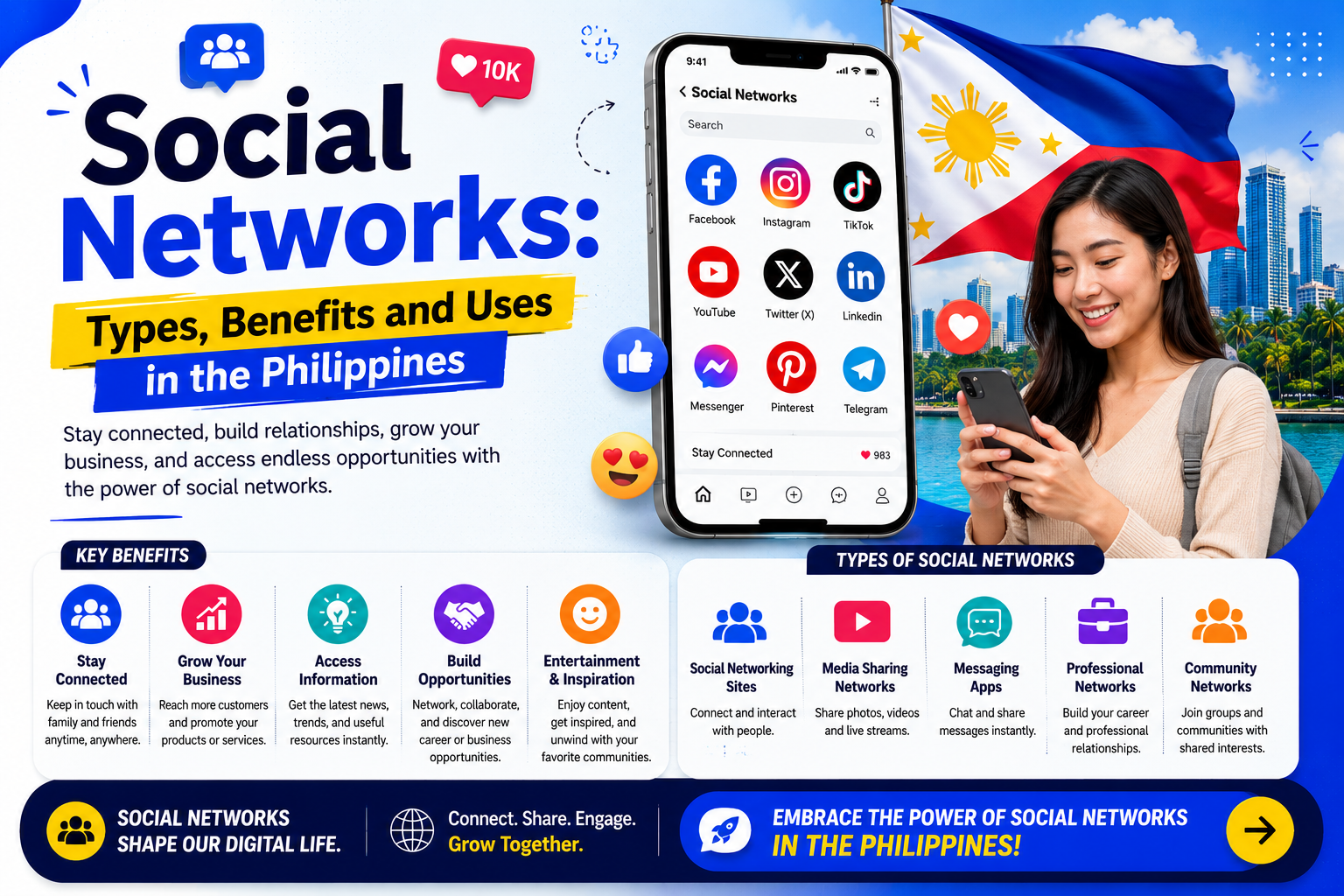
What Are Social Networks? Types, Benefits, and How They Work?
Open your phone and look at the apps you use every day. Facebook, Messenger, Instagram, TikTok, YouTube, LinkedIn, or another online community is probably somewhere on the screen. For millions of Filipinos, these platforms are part of everyday communication, entertainment, shopping, work, and business. DataReportal’s Digital 2026 Philippines report estimated 95.8 million social media user identities in the Philippines in October 2025, equivalent to 81.9% of the country’s population. This figure should not be interpreted as 95.8 million unique individuals because one person may have multiple accounts or identities across platforms.
So, what exactly are social networks? How do they work, what types are available, and why have they become such an important part of everyday life in the Philippines? This guide explains it in simple terms.
What Are Social Networks?
A social network is an online system that allows people, businesses, organizations, and communities to connect and interact with one another.
Think of it as a digital neighborhood.
Your connections might include:
- Family members
- Friends
- Classmates
- Coworkers
- Customers
- Professional contacts
- Creators
- People who share the same interests
Instead of being limited by physical location, an online social network can connect someone in Manila with a relative in Dubai, a customer in Cebu, or a professional contact on the other side of the world. The main idea behind social networking is connection. Users create profiles, connect with other users, publish content, communicate, and participate in online communities.
Definition of Social Networks
In simple terms, a social network is a digital structure that connects individuals or groups through relationships, shared interests, professional connections, communities, or activities. The concept of social networks existed long before modern social media. What the internet changed was the scale and speed at which these networks could form. Today, a person can build hundreds or thousands of digital connections through a single platform.
Key Features of Social Networks
Different platforms work in different ways, but most social networking sites include some common features.
These may include:
- User profiles
- Friends, followers, or connections
- News feeds
- Posts
- Photos
- Videos
- Stories
- Private messaging
- Comments
- Reactions
- Sharing
- Groups or communities
- Search and discovery tools
Not every platform offers all of these features, but most modern social networks combine several of them.
How Social Networks Connect People
Imagine a group of people where every person is connected to several others. One friend introduces you to another person. That person connects you with someone else. Soon, a large network develops. Online social networks work in a similar way.
Connections between users create a larger network through which:
- Information travels
- Content gets shared
- Communities form
- Relationships develop
- Businesses reach customers
- Professionals find opportunities
This interconnected structure is one of the main reasons information can spread so quickly online.
How Do Social Networks Work?
Most social networking platforms follow a relatively simple process. A user creates an account, builds a profile, connects with other people or accounts, and begins interacting with content. Behind that simple experience, platforms use complex technology to organize enormous amounts of information.
Creating a Social Network Profile
A profile represents your identity on a social networking platform.
Depending on the platform, it may include:
- Your name
- Profile photo
- Biography
- Location
- Education
- Work experience
- Interests
- Website
- Business information
- Posts and videos
For individuals, a profile can represent a personal or professional identity. For businesses, it can act as a digital storefront where customers learn about the company and interact with the brand.
Building Friends, Followers, and Connections
Different platforms use different relationship models. Some use friends, where both people approve the connection. Others use followers, where one person can follow another without requiring a mutual connection. Professional platforms may use connections. The terminology changes, but the purpose is similar: creating relationships between accounts.
Sharing Posts, Photos, Videos, and Stories
Social networks allow users to publish many types of content.
Common formats include:
- Text posts
- Photos
- Short videos
- Long-form videos
- Stories
- Livestreams
- Articles
- Links
- Polls
- Audio
- Product content
Different platforms emphasize different formats. Instagram focuses heavily on visual content, LinkedIn is built around professional communication, YouTube centers on video, and Facebook combines several formats within one ecosystem.
Likes, Comments, Shares, and Other Interactions
Social networking is different from simply reading a traditional website because users can interact directly with content and with one another.
Common interactions include:
- Liking
- Reacting
- Commenting
- Sharing
- Saving
- Following
- Messaging
- Tagging
These actions help conversations develop and can also provide platforms with information about what users find interesting.
Algorithms and Content Discovery
Modern social networks contain far more content than one person could ever view. For that reason, platforms use recommendation and ranking systems to decide which content appears in feeds, search results, and discovery sections. These systems may consider different signals depending on the platform, including a user’s previous interactions, interests, connections, and the content itself.
The exact systems vary between platforms and change over time. For users, the practical result is simple: the content appearing in your feed is usually personalized rather than shown in a completely random order.
Finding Communities and New Connections
Social networks also help people discover others outside their existing circle.
Discovery may happen through:
- Groups
- Suggested accounts
- Search
- Hashtags
- Recommended content
- Shared connections
- Communities
- Trending topics
This allows someone interested in gardening, gaming, freelancing, cooking, business, fitness, or almost any other subject to find people with similar interests.
History and Evolution of Social Networks
Online social networking developed gradually. Researchers generally identify SixDegrees.com, launched in 1997, as one of the first recognizable social network sites because it combined profiles, friend lists, and visible connections between users. Later platforms expanded the idea. Friendster, MySpace, Facebook, LinkedIn, YouTube, Instagram, and TikTok each helped shape different parts of the modern social networking experience.
The Six Degrees Idea
The phrase “six degrees of separation” describes the idea that people may be connected through surprisingly short chains of relationships. Modern social networks made those relationship chains much easier to see. Instead of connections existing only offline, digital platforms allowed users to create visible networks of friends, colleagues, followers, and communities.
Early Social Networking Sites
SixDegrees.com combined several features that later became standard in social networking, including profiles and visible friend connections.
Other platforms followed and experimented with:
- Personal profiles
- Friend lists
- Messaging
- Photos
- Groups
- Public updates
These early services helped establish the basic model used by many platforms today.
The Rise of Facebook
Facebook helped bring social networking into mainstream everyday internet use. Its combination of profiles, friends, Pages, Groups, photos, messaging, feeds, and later video helped turn social networking into something people could use for both personal communication and public content. Today, Facebook remains one of the largest digital platforms in the Philippines. Meta’s advertising tools indicated a potential Facebook ad audience of roughly 95.8 million in the Philippines in late 2025. Advertising reach is not the same as monthly active users, so this number should be understood as an estimate of potential advertising reach rather than a confirmed count of unique Facebook users.
The Growth of YouTube and Instagram
YouTube helped make online video a major form of digital communication, education, entertainment, and creator content. Google’s advertising tools indicated that YouTube had a potential advertising reach of 59.6 million people in the Philippines in late 2025. Instagram developed around visual sharing and later expanded heavily into video, messaging, Stories, Reels, shopping, and creator features. Meta’s advertising tools indicated an Instagram potential ad audience of approximately 26.9 million in the Philippines in late 2025.
The Emergence of LinkedIn
LinkedIn developed a different kind of social network: one focused primarily on professional relationships. LinkedIn officially launched in 2003 and describes itself as a professional network connecting people for career and business opportunities.
People use LinkedIn for:
- Job searching
- Recruitment
- Professional networking
- Personal branding
- Business development
- Industry discussions
- Company updates
LinkedIn’s advertising resources reported approximately 22 million registered members in the Philippines in late 2025. This figure represents registered members, so it is not directly comparable with active-user or advertising-reach figures from other platforms.
The Rise of TikTok and Short-Form Content
TikTok accelerated the popularity of short-form vertical video. Its recommendation-driven format helped make quick tutorials, entertainment, trends, storytelling, reviews, and creator content central to modern social media culture. TikTok’s advertising resources indicated an audience of about 64 million users aged 18 and above in the Philippines in late 2025.
The Evolution of Social Networking Platforms
Social networks continue to evolve.
Modern platforms increasingly combine:
- Social networking
- Entertainment
- Messaging
- Search
- Shopping
- Livestreaming
- Creator tools
- Advertising
- Artificial intelligence
- Business services
This means the difference between a social network, media platform, messaging app, marketplace, and entertainment service is becoming less clear.
Types of Social Networks
Not every social network serves the same purpose. Understanding the different types makes it easier to see why people use different platforms for different needs.
Horizontal Social Networks
These platforms serve a broad audience rather than one specific interest.
Examples:
Best for:
- General communication
- Friends and family
- Communities
- Businesses
- Entertainment
- News and updates
Professional Social Networks
These focus on careers, employment, business, and professional relationships.
Example:
Best for:
- Job searching
- Recruitment
- Professional branding
- Business networking
- Industry knowledge
Media-Sharing Social Networks
These focus heavily on visual or video content.
Examples:
- YouTube
Best for:
- Photos
- Videos
- Inspiration
- Tutorials
- Creator content
- Brand promotion
Short-Form and Entertainment Networks
These emphasize entertainment, trends, creators, and short-form content.
Examples:
- TikTok
- Twitch for livestream-focused communities
Best for:
- Entertainment
- Trends
- Gaming
- Livestreaming
- Creator discovery
Interest-Based Social Networks
These are built around particular hobbies or interests.
Examples:
- Goodreads for books
- Strava for fitness and sports
Best for:
- Niche communities
- Shared activities
- Recommendations
- Progress tracking
- Discussion
Community-Based Networks
Community platforms bring people together around shared topics, interests, questions, or experiences.
These may include:
- Forums
- Facebook Groups
- Reddit communities
- Specialized online communities
Best for:
- Discussion
- Advice
- Support
- Shared interests
- Community building
Popular Social Networks in the Philippines
Comparing platform sizes requires caution because companies report their audiences differently. Some publish advertising reach, some report adult audiences, and LinkedIn reports registered members. The figures below therefore should not be treated as directly comparable monthly active user counts.
Meta’s advertising tools indicated a potential Facebook audience of approximately 95.8 million in the Philippines in late 2025.
Facebook is commonly used for:
- Personal connections
- Groups
- Business Pages
- Marketplace activity
- Videos
- Reels
- Community discussions
Messenger
Meta reported a potential Messenger advertising audience of approximately 65.8 million in the Philippines in late 2025.
Messenger is particularly useful for:
- Personal conversations
- Family group chats
- Customer enquiries
- Business communication
- Voice and video calls
TikTok
TikTok’s advertising tools indicated approximately 64 million users aged 18 and above in the Philippines in late 2025.
TikTok is commonly associated with:
- Short-form video
- Entertainment
- Trends
- Creator content
- Product discovery
- Social commerce
YouTube
YouTube’s potential advertising reach in the Philippines stood at about 59.6 million in late 2025.
Common uses include:
- Entertainment
- Tutorials
- Education
- Music
- Reviews
- Vlogs
Instagram’s potential advertising audience in the Philippines was approximately 26.9 million in late 2025.
People use Instagram for:
- Photos
- Reels
- Stories
- Creators
- Brands
- Messaging
- Product discovery
LinkedIn reported approximately 22 million registered members in the Philippines in late 2025.
It is primarily used for:
- Careers
- Recruitment
- Professional networking
- Business content
- Personal branding
X
X’s advertising resources indicated a potential audience of approximately 7.98 million in the Philippines in late 2025.
It is commonly used for:
- Real-time discussions
- News commentary
- Public conversations
- Entertainment updates
Benefits of Social Networks
Social networks provide benefits far beyond entertainment. They have changed how people maintain relationships, build careers, learn, create businesses, and participate in communities.
Staying Connected With Family and Friends
For families living across different cities or countries, social networks make communication easier.
People can use:
- Group chats
- Video calls
- Photos
- Stories
- Voice messages
- Private messages
Distance becomes less of a barrier to everyday communication.
Building Professional Connections
Professional social networks can help people:
- Connect with recruiters
- Find job opportunities
- Meet potential clients
- Build professional credibility
- Learn about industries
- Share expertise
A strong online professional presence can complement a traditional resume and portfolio.
Learning and Sharing Knowledge
Social networks allow people to learn directly from:
- Teachers
- Professionals
- Creators
- Businesses
- Communities
- Other users
Educational content may include:
- Tutorials
- Language lessons
- Financial literacy
- Cooking
- Technology
- Career advice
- DIY projects
- Academic discussions
Building Communities
People can join communities based on:
- Hobbies
- Location
- Profession
- Health experiences
- Parenting
- Entertainment
- Education
- Business
- Sports
These communities can provide information, conversation, support, and a sense of belonging.
Importance of Social Networks in Everyday Life
Social networks now influence many parts of daily life.
People use them to:
- Communicate
- Find information
- Discover businesses
- Search for jobs
- Watch entertainment
- Learn new skills
- Follow news
- Shop
- Build communities
In the Philippines, social media has an especially large digital footprint. DataReportal estimated 95.8 million social media user identities in late 2025, while 97.7% of the country’s internet-user base used at least one social platform according to its 2026 report. That level of adoption helps explain why social networking now plays such a large role in personal and commercial communication.
Social Networks for Personal Communication
Personal communication remains one of the most important uses of social networking.
Family members and friends can communicate through:
- Messenger
- Group chats
- Video calls
- Photos
- Voice notes
- Stories
This is particularly useful when family members live or work in different countries. Social networks allow relationships to continue across distance without relying entirely on traditional phone calls or face-to-face communication.
Social Networks for Professional Networking
Professional networking has also moved online.
Platforms such as LinkedIn allow users to:
- Display work experience
- Highlight skills
- Build professional connections
- Follow companies
- Find vacancies
- Communicate with recruiters
- Publish professional content
LinkedIn says its network has more than one billion members globally and is specifically designed around professional connections and economic opportunity. For Filipino job seekers, freelancers, professionals, and business owners, this makes online networking another useful channel for building career opportunities.
Social Networks for Businesses and Brands
For businesses in the Philippines, social networks can function as marketing channels, customer-service tools, content platforms, and even sales channels.
A small business can create an online presence before investing heavily in traditional advertising.
Building Brand Awareness
Consistent social media activity can help more people become familiar with a brand.
Businesses can publish:
- Product photos
- Videos
- Reels
- Customer stories
- Educational content
- Behind-the-scenes posts
The goal is to become recognizable to the right audience.
Connecting With Customers
Comments and direct messages allow customers to contact businesses quickly.
They may ask about:
- Prices
- Availability
- Delivery
- Store locations
- Product details
- Support
This direct communication can make social networks an important part of modern customer service.
Social Network Marketing
Businesses can combine organic content with:
- Paid advertising
- Influencer collaborations
- Creator partnerships
- Community marketing
- Social commerce
This can help brands reach audiences beyond their existing followers.
Generating Website Traffic
Social profiles can direct visitors toward:
- Websites
- Product pages
- Booking systems
- Blogs
- Online stores
- Contact forms
A strong social post may introduce someone to a business and encourage them to learn more elsewhere.
Increasing Customer Engagement
Interactive formats can encourage customers to participate.
Examples include:
- Polls
- Questions
- Livestreams
- Contests
- Product demonstrations
- Comment discussions
Engagement should be useful and relevant rather than created only for numbers.
Building Online Communities
Businesses can also create communities around their products, services, or shared interests.
A strong community can help customers:
- Ask questions
- Share experiences
- Learn from one another
- Provide feedback
- Stay connected with the brand
Growing Leads and Sales
Social networks can support sales by helping businesses move potential customers from discovery to enquiry or purchase. The exact process depends on the platform and business.
For some brands, the path may be:
Post → Profile → Website → Purchase
For others:
Video → Message → Conversation → Sale
Social Networks for Education and Knowledge Sharing
Social networking is also an important learning tool.
Students and professionals can use social platforms to find:
- Tutorials
- Study communities
- Educational videos
- Career guidance
- Professional discussions
- Free learning resources
Learning is no longer limited to schools, libraries, or textbooks. A person can learn cooking from YouTube, finance from an educational creator, or software skills through professional communities. The quality of online information varies, so important claims should still be checked against reliable sources.
Social Networks and Online Communities
One of the strongest features of social networks is their ability to connect people around shared interests rather than physical location.
Someone can join a community for:
- K-pop
- Books
- Fitness
- Parenting
- Gaming
- Freelancing
- Business
- Health support
- Travel
That creates networking opportunities that might not exist locally. A person with a highly specific interest can often find an online community of people who understand the same topic.
Social Networks vs. Social Media
The terms social networks and social media are often used interchangeably. There is a difference, although modern platforms frequently combine both.
Social Networks
The main focus is on relationships and connections.
Examples include:
People connect with friends, colleagues, businesses, or communities.
Social Media
The main focus is on creating and distributing content.
Examples may include platforms heavily centered on:
- Video
- Photos
- News
- Public posts
- Entertainment
YouTube and TikTok are often described more as content-driven social media platforms.
Hybrid Platforms
Most modern platforms now do both. Instagram, Facebook, TikTok, X, and other services combine content publishing with social relationships and communication.
Difference Between Social Networks and Social Media
A simple way to remember the distinction is:
- Social network: focuses on who you are connected to.
- Social media: focuses on what content is being shared.
In practice, the two overlap heavily.
Are Social Networks and Social Media the Same?
Not exactly. But in everyday conversation, using the terms interchangeably is usually understandable because most major platforms now include both networking and media features.
How Social Networks Have Changed Communication
Social networks have made communication faster and more flexible.
People can now communicate through:
- Text
- Photos
- Video
- Voice messages
- Video calls
- Group chats
- Public posts
A conversation no longer requires everyone to be in the same place or even online at the same time. This has changed both personal and professional communication. Businesses can respond to customers through Messenger. Families can maintain group conversations across countries. Professionals can build networks without meeting in person first.
Privacy and Security on Social Networks
The benefits of social networking also come with privacy and security responsibilities. The Philippines’ National Privacy Commission warns that personal information shared online can be misused for identity theft, fraud, harassment, stalking, and other harmful activities. Users should understand what information they make public and how their privacy settings work.
Protecting Personal Information
Be careful about publicly sharing sensitive information such as:
- Full home address
- Financial information
- Identification documents
- Private contact details
- Travel details
- Account passwords
The National Privacy Commission specifically advises people against oversharing personal information on social media because criminals may collect these details for identity theft or fraud.
Managing Privacy Settings
Review the privacy controls provided by the platforms you use.
Depending on the service, you may be able to control:
- Who sees your posts
- Who sends friend requests
- Who can message you
- Who can tag you
- Whether your profile appears publicly
- Which applications access your data
Privacy settings can change as platforms update their products, so reviewing them periodically is useful.
Avoiding Online Scams and Fake Profiles
Be cautious when an account:
- Requests money unexpectedly
- Offers unrealistic investment returns
- Sends suspicious links
- Pretends to represent a known organization
- Asks for passwords or verification codes
- Creates unnecessary urgency
The National Privacy Commission has repeatedly warned Filipino users about fake accounts, fraudulent websites, phishing, and other attempts to obtain personal information.
Safe Social Networking Practices
Useful safety habits include:
- Use strong, unique passwords.
- Enable two-factor authentication when available.
- Review privacy settings.
- Avoid oversharing personal data.
- Verify unexpected messages.
- Be careful with unfamiliar links.
- Report suspicious accounts.
- Keep applications and devices updated.
Small security habits can significantly reduce unnecessary risk.
The Future of Social Networks
Social networking continues to evolve quickly. The next generation of platforms is likely to combine even more features in one experience.
Current trends already include:
- Artificial intelligence
- Personalized recommendations
- Social commerce
- Livestream shopping
- Creator tools
- Short-form video
- Private communities
- Business messaging
- Integrated payment and shopping experiences
In the Philippines, the large existing digital audience creates strong opportunities for creators, businesses, professionals, and communities to continue using social platforms in new ways. DataReportal’s 2026 figures show how deeply social media is already embedded in the country’s internet use. The platforms will continue changing, but the basic purpose of a social network is likely to remain the same connecting people, communities, information, and opportunities.
Frequently Asked Questions About Social Networks
What Is a Social Network?
A social network is an online system that connects individuals, businesses, or communities through relationships, shared interests, professional connections, or activities.
What Is the Difference Between a Social Network and Social Media?
A social network focuses mainly on connections between people, while social media focuses more broadly on creating and distributing content.
Most modern platforms combine both functions.
What Is the Most Popular Social Network in the Philippines?
Facebook has one of the largest reported digital audiences in the Philippines. Meta’s advertising tools indicated a potential Facebook ad audience of approximately 95.8 million in late 2025. However, advertising reach should not be treated as a confirmed monthly active user count.
What Are Examples of Social Networks?
Common examples include:
- TikTok
- X
- Interest-based communities
Different platforms focus on different types of connections and content.
Are Social Networks Safe to Use?
Social networks can be used safely when users take appropriate precautions. Use strong passwords, enable two-factor authentication, review your privacy settings, avoid oversharing personal information, and be cautious with suspicious links and accounts. The Philippines’ National Privacy Commission also recommends careful handling of personal data on social platforms.
How Do Businesses Benefit From Social Networks?
Businesses can use social networks for:
- Brand awareness
- Customer communication
- Content marketing
- Advertising
- Community building
- Website traffic
- Lead generation
- Sales support
The best approach depends on the business and its audience.
How Do Social Networks Help Students?
Students can use social networks to:
- Join study communities
- Find tutorials
- Discuss subjects
- Follow educational creators
- Share resources
- Build professional connections
Information found on social platforms should still be evaluated carefully before being used for important academic or professional decisions.
What Is the Future of Social Networking?
Social networking is becoming increasingly connected with artificial intelligence, creator tools, short-form video, private communities, shopping, and business communication. The technology will continue changing, but connecting people and communities will remain at the center of social networking.
Final Thoughts
Social networks have become an important part of everyday life in the Philippines.
They help people:
- Stay connected with family and friends
- Build professional relationships
- Learn new skills
- Discover communities
- Promote businesses
- Communicate with customers
- Find entertainment
- Share information
With an estimated 95.8 million social media user identities in the Philippines in late 2025, the scale of the country’s online social environment is significant.
The real value of social networks is not simply how many apps we use or how many followers we collect. It is how effectively we use those networks to create meaningful connections, access useful information, build opportunities, and communicate with others.
Used thoughtfully and safely, social networks can be powerful tools for individuals, professionals, communities, and businesses across the Philippines.
SEO Title: Social Networks: Types, Benefits and Uses in the Philippines
Meta Description: Learn what social networks are, how they work, their types, benefits, business uses, privacy tips, and popular platforms in the Philippines.