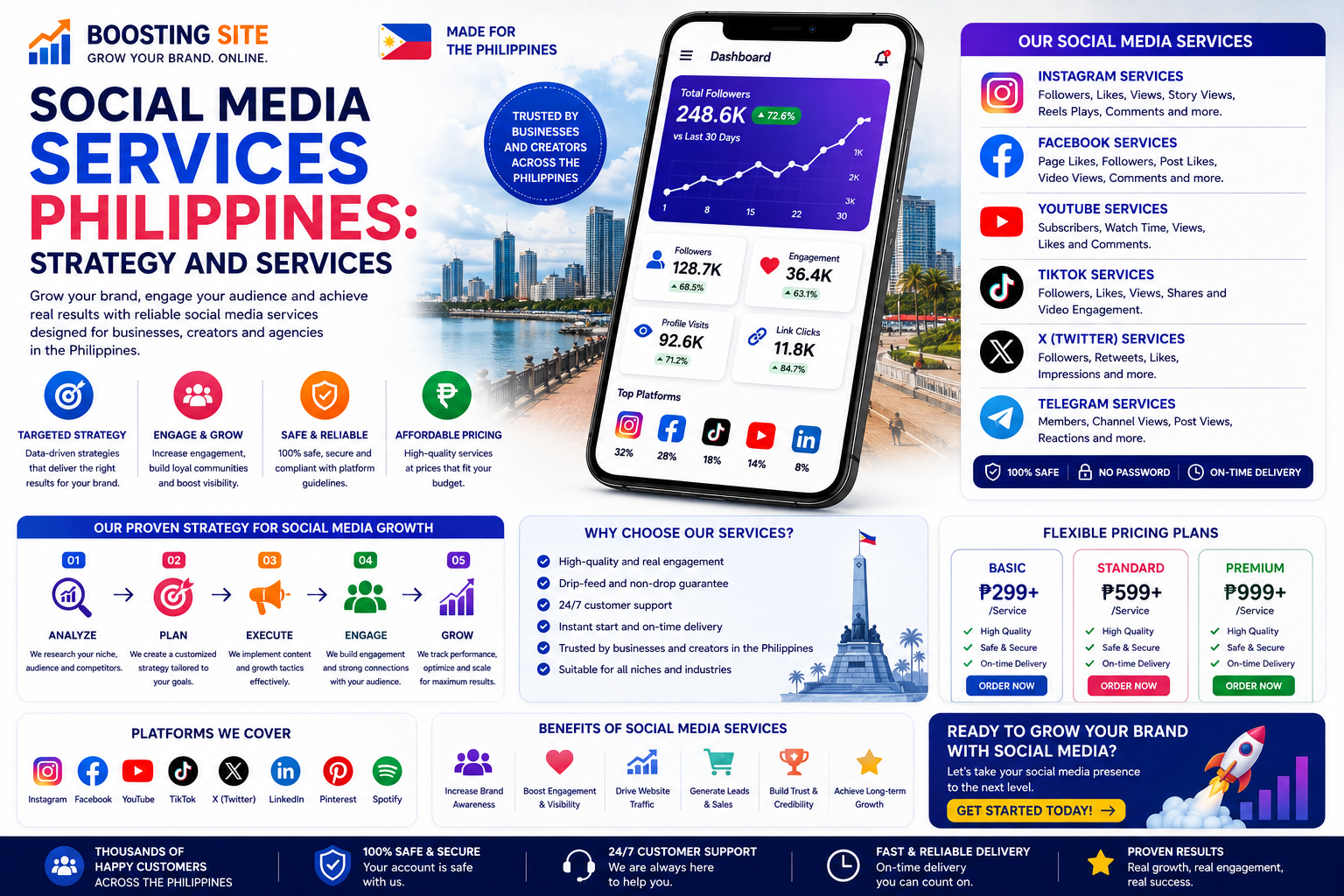
Social Media Services in the Philippines: The Complete Social Media Marketing Strategy Guide for 2026
Social media services helps businesses use platforms such as Facebook, Instagram, TikTok, YouTube, and LinkedIn to build awareness, communicate with customers, promote products, generate leads, and support sales. In the Philippines, social media plays a particularly important role in the digital customer journey.
DataReportal’s Digital 2026 Philippines report estimates that the country had:
- 98 million internet users
- 95.8 million social media user identities
- 137 million cellular mobile connections
in late 2025. Social media user identities were equivalent to 81.9% of the country’s population, although DataReportal cautions that these identities should not automatically be interpreted as 95.8 million unique individuals. For Philippine businesses, this creates opportunities to reach customers where they already discover products, communicate with brands, watch videos, compare options, and make purchasing decisions. But social media marketing is more than posting.
A successful strategy combines:
- Audience research
- Content planning
- Social media management
- Community engagement
- Paid advertising
- Creator partnerships
- Social commerce
- Analytics
- Continuous optimization
This guide explains how social media marketing in the Philippines works and how businesses can build a practical strategy around real customer behaviour.
What Is Social Media Marketing?
Social media marketing means using social platforms strategically to achieve marketing and business goals.
Those goals may include:
- Building brand awareness
- Growing an audience
- Increasing customer engagement
- Generating website traffic
- Collecting enquiries
- Creating qualified leads
- Supporting ecommerce
- Improving customer communication
- Generating sales
Social media marketing includes both organic and paid activities.
Organic Social Media
Organic activity can include:
- Facebook posts
- Instagram Reels
- TikTok videos
- YouTube content
- Stories
- Comments
- Community discussions
- Customer replies
Paid Social Media
Paid activity can include:
- Boosted content
- Awareness campaigns
- Website traffic campaigns
- Lead-generation ads
- Message campaigns
- Retargeting
- Ecommerce campaigns
Influencer Marketing
Brands may also work with creators to reach relevant communities through:
- Product demonstrations
- Reviews
- Sponsored content
- Tutorials
- Affiliate campaigns
- Livestream content
Community Management
Community management covers activities such as:
- Replying to comments
- Answering messages
- Managing customer questions
- Moderating discussions
- Collecting feedback
A strong social media strategy brings these activities together instead of treating them as unrelated tasks.
How Does Social Media Marketing Work?
Social media marketing works as an ongoing cycle.
A practical process looks like this:
- Define the business goal.
- Identify the target audience.
- Choose the right platforms.
- Create relevant content.
- Publish consistently.
- Promote selected content where appropriate.
- Respond to customers.
- Measure results.
- Improve future campaigns.
Different platforms use different recommendation and advertising systems. There is no universal algorithm formula that guarantees reach.
Instead of trying to “beat the algorithm,” businesses should focus on:
- Clear topics
- Relevant audiences
- Useful content
- Strong creative
- Customer response
- Measurable outcomes
Social Media Marketing vs. Social Media Management
These terms are related but not identical.
Social Media Management
Usually focuses on day-to-day execution.
It may include:
- Scheduling posts
- Publishing content
- Replying to comments
- Answering messages
- Updating profiles
- Managing a content calendar
Social Media Marketing
Has a wider strategic focus.
It may include:
- Marketing goals
- Audience strategy
- Campaign planning
- Advertising
- Lead generation
- Conversion tracking
- Performance analysis
A Philippine social media services provider may offer both. Before hiring one, check exactly what is included in the package.
Why Social Media Marketing Matters for Businesses?
A large share of the Philippine population uses internet and social platforms. That gives businesses an opportunity to connect with potential customers at several stages of the buying journey.
Build Brand Awareness
Social media can introduce your brand to people who have never purchased from you.
Discovery can happen through:
- Organic posts
- Videos
- Search
- Recommendations
- Creator content
- Shares
- Paid advertising
Repeated useful exposure can make a business easier to recognize over time.
Reach Relevant Customers
The goal should not simply be maximum reach. It should be relevant reach.
For example:
- A café in Cebu needs customers it can actually serve.
- A Manila-based B2B agency may want decision-makers rather than general consumers.
- An ecommerce brand shipping nationwide may benefit from a broader audience.
Use customer information to guide your social strategy.
Consider:
- Location
- Language
- Age
- Interests
- Customer needs
- Purchase behaviour
Increase Customer Engagement
Social media allows two-way communication.
Customers can:
- Comment
- Ask questions
- Send messages
- Share feedback
- React
- Save content
- Share posts
Businesses can then use these conversations to understand customer interests and concerns. Repeated questions can also become future content topics.
Generate Website Traffic
Social platforms can direct users toward:
- Product pages
- Service pages
- Booking systems
- Blog articles
- Contact forms
- Ecommerce stores
Use clear calls to action.
Examples:
- Visit our website.
- View the full menu.
- Book your appointment.
- Request a quotation.
- Shop the collection.
Use tracked links where possible so you can identify which campaigns actually generate traffic.
Generate Leads and Sales
Social media can help move potential customers toward:
- Messages
- Calls
- Forms
- Bookings
- Registrations
- Purchases
However, a social-media interaction does not automatically become a sale.
Conversion also depends on:
- The offer
- Pricing
- Customer service
- Website experience
- Product quality
- Payment options
- Follow-up
Improve Customer Service
Social media can become an important communication channel.
Customers may contact businesses to ask about:
- Price
- Availability
- Delivery
- Store hours
- Booking
- Product details
- Order status
Businesses should create a realistic system for responding to important enquiries. Fast response can be useful, but there is no universal response-time benchmark that applies to every Philippine company.
Build Brand Trust
Potential customers often evaluate businesses before purchasing.
A complete social presence can help them review:
- Recent posts
- Customer comments
- Product demonstrations
- Reviews
- Testimonials
- Company information
- Responses to questions
Trust comes from genuine information and customer experience rather than follower count alone.
Social Media Services Philippines: What Businesses Can Use
A professional social media services Philippines package may include several different services.
Social Media Strategy
This may include:
- Goal setting
- Target-audience research
- Platform selection
- Competitor research
- Content themes
- KPI planning
Content Creation
Content services may include:
- Graphics
- Reels
- Short videos
- Carousels
- Captions
- Stories
- Long-form videos
Social Media Management
This may cover:
- Scheduling
- Publishing
- Account maintenance
- Content-calendar management
- Comment moderation
Community Management
This can include:
- Replying to customers
- Managing DMs
- Handling routine questions
- Monitoring customer feedback
Paid Advertising
Advertising services may include:
- Campaign setup
- Audience selection
- Creative testing
- Retargeting
- Lead campaigns
- Sales campaigns
- Reporting
Influencer Marketing
Agencies may help with:
- Creator research
- Outreach
- Campaign planning
- Deliverables
- Usage rights
- Reporting
Analytics and Reporting
Reports may cover:
- Reach
- Engagement
- Traffic
- Leads
- Advertising results
- Conversions
- Revenue where trackable
How to Create a Social Media Marketing Strategy?
A good social media marketing strategy begins with a small number of clear decisions.
1. Define Your Marketing Goals
Choose goals connected with real business outcomes.
Examples:
- Increase brand awareness
- Generate enquiries
- Increase website traffic
- Get more bookings
- Generate qualified leads
- Promote a new product
- Increase online sales
Avoid making follower growth the only goal. Followers may be useful, but they are a supporting metric rather than the entire strategy.
2. Understand Your Target Audience
Go beyond age and gender.
Research:
- Location
- Language
- Interests
- Customer problems
- Buying behaviour
- Preferred content formats
- Preferred platforms
For Philippine audiences, language may include:
- English
- Filipino
- Taglish
- Cebuano
- Other regional languages
Use the language that fits your actual customers.
3. Research Competitors
Review relevant competitors.
Look at:
- Which platforms they use
- What topics they cover
- What customers ask
- Which posts receive useful interaction
- What information is missing
The goal is not to copy. Look for gaps you can fill better.
4. Choose the Right Platforms
Do not open an account everywhere simply because the platform exists. Start with the channels most relevant to your audience.
A practical business may begin with:
- One primary platform
- One supporting platform
Then expand when resources and evidence justify it.
5. Create Content Themes
Organize content into repeatable categories.
For example:
Educational Content
- Tutorials
- Tips
- FAQs
- Guides
Product Content
- Demonstrations
- Features
- Comparisons
- New releases
Trust Content
- Customer reviews
- Behind-the-scenes posts
- Team content
- Testimonials
Community Content
- Questions
- Polls
- Discussions
- Customer stories
Promotional Content
- Offers
- Campaigns
- Sales
- Launches
There is no universal content ratio such as 40-30-20-10 or 80-20 that every business should follow. Use customer response and analytics to determine the correct mix.
6. Build a Content Calendar
A content calendar makes publishing easier to manage.
Plan around:
- Product launches
- Seasonal demand
- Local events
- Business campaigns
- Evergreen topics
- Important customer questions
Philippine businesses may also plan campaigns around relevant:
- Christmas shopping
- School periods
- Summer
- Local festivals
- Payday promotions
- Major ecommerce events
Use only the events that genuinely fit the business.
7. Create a Sustainable Posting Schedule
There is no universal posting frequency. Three posts per week are not automatically better than five.
The best schedule is one that:
- Maintains quality
- Fits your resources
- Serves your audience
- Can be sustained consistently
Test different frequencies and review performance.
8. Engage With Customers
Do not publish and disappear.
Reply to meaningful:
- Questions
- Comments
- Messages
- Complaints
- Product enquiries
Also turn recurring customer questions into future content.
9. Use Paid Advertising Strategically
Paid advertising can support:
- Awareness
- Traffic
- Leads
- Messages
- Sales
- Retargeting
Start with a clear objective. Do not spend simply because the platform suggests boosting a post.
10. Measure and Improve
Review what actually happens.
Ask:
- Which content attracts attention?
- Which posts generate profile visits?
- Which platform generates enquiries?
- Which ads create qualified leads?
- Which campaigns contribute to sales?
Use those answers to improve the next month.
Best Social Media Platforms in the Philippines
Platform statistics need to be interpreted carefully because companies report different types of audience figures. According to DataReportal’s Digital 2026 Philippines report, reported platform audiences in late 2025 included the following.
Potential advertising reach:
Approximately 95.8 million
Useful for:
- Local businesses
- Communities
- Broad consumer audiences
- Video
- Customer communication
- Advertising
Meta advertising reach should not automatically be treated as confirmed monthly active users.
TikTok
TikTok’s advertising resources reported approximately:
64 million users aged 18 and above
Useful for:
- Short-form video
- Product discovery
- Creator content
- Entertainment
- Social commerce
TikTok Shop Seller Centre remains officially available in the Philippines as of June 2026.
YouTube
Potential advertising reach:
Approximately 59.6 million
Useful for:
- Tutorials
- Reviews
- Product demonstrations
- Educational videos
- Shorts
- Long-form content
Google advertising reach should not automatically be interpreted as monthly active users.
Potential advertising reach:
Approximately 26.9 million
Useful for:
- Fashion
- Food
- Beauty
- Travel
- Lifestyle
- Visual brands
- Reels
Meta reported Instagram ad reach equivalent to about 22.9% of the Philippine population in late 2025.
LinkedIn reported approximately:
22 million registered members
Useful for:
- B2B marketing
- Recruitment
- Professional services
- Employer branding
- Business networking
Because LinkedIn reports registered members, its audience should not be directly compared with advertising-reach figures from other platforms.
Which Platform Should You Choose?
Choose based on customer relevance rather than audience size alone.
For example:
- Local consumer business: Facebook or Instagram may be useful.
- Visual consumer brand: Instagram or TikTok may be appropriate.
- Video education: YouTube may be stronger.
- B2B company: LinkedIn may be more relevant.
- Social-commerce business: TikTok may deserve testing.
Always use your own analytics and customer data.
How to Create Content That Performs?
There is no single format that always wins.
Good social content usually has:
- A clear topic
- A useful reason to watch or read
- Easy-to-understand creative
- Relevant examples
- A logical next step
Educational Content
Useful examples include:
- Tutorials
- FAQs
- Buying guides
- Comparisons
- Checklists
- Explainers
Specific content is often more useful than vague motivational content.
Short-Form Video
Short videos can work well for:
- Quick demonstrations
- Product highlights
- Tips
- Behind-the-scenes content
- Simple stories
Keep important information easy to understand on mobile devices. Subtitles can also improve accessibility.
User-Generated Content
UGC can include:
- Customer photos
- Reviews
- Videos
- Product demonstrations
Use genuine customer material with appropriate permission. Do not create fake customer reviews or testimonials.
Influencer Content
Creator content can introduce a business to another audience.
Evaluate creators based on:
- Audience relevance
- Location
- Content quality
- Brand fit
- Engagement quality
- Previous collaborations
Follower count alone should not determine the decision.
Interactive Content
Useful formats can include:
- Polls
- Question boxes
- Quizzes
- Q&A sessions
These can encourage participation and provide customer insight.
How to Increase Social Media Engagement?
Engagement improves when content gives customers something meaningful to respond to.
Write Clear Captions
Start with the main idea. Avoid long introductions when the customer wants a quick answer. Use one clear call to action when appropriate.
Examples:
- Tell us which option you prefer.
- Message us for availability.
- Save this guide for later.
- View the full collection.
Respond to Customers
Reply to meaningful questions and conversations. Prepare saved responses for common questions, but keep human involvement for more complicated situations. Automation can support customer service without replacing it completely.
Encourage Conversations
Ask questions related to your customer’s real interests.
For example:
- Which style would you choose?
- What problem should we explain next?
- Which product feature matters most to you?
Use Social Listening
Social listening means monitoring conversations related to:
- Your brand
- Competitors
- Products
- Customer problems
- Industry topics
Smaller businesses can begin with native platform search and customer comments before investing in expensive monitoring tools.
Social Media Advertising and Paid Promotion
Paid social advertising gives businesses additional distribution and targeting options.
Organic vs. Paid Social Media
Organic Social Media
Useful for:
- Community
- Trust
- Customer relationships
- Content history
- Long-term presence
Paid Social Media
Useful for:
- Additional reach
- Campaign targeting
- Leads
- Traffic
- Sales
- Retargeting
The two can work together.
How Paid Social Advertising Works?
A typical campaign involves:
- Selecting an objective.
- Choosing an audience.
- Setting a budget.
- Uploading creative.
- Selecting placements or allowing automated placement.
- Launching the campaign.
- Measuring performance.
Advertising platforms generally use auction-based systems.
Actual cost depends on multiple factors, including:
- Competition
- Audience
- Objective
- Creative
- Placement
- Timing
There is no fixed Philippine CPC or CPM that applies to every campaign.
Boosted Post vs. Full Ad Campaign
A boosted post is still a form of paid advertising. It usually offers a simpler campaign setup around existing content.
Full advertising managers generally provide more control over areas such as:
- Audiences
- Placements
- Retargeting
- Conversion tracking
- Creative testing
- Campaign structure
Choose according to the campaign objective and complexity.
Audience Targeting
Possible audience strategies may include:
- Geographic targeting
- Relevant interests
- Existing customer audiences
- Website visitors
- Previous engagers
Available targeting options depend on the platform and privacy rules. Avoid unnecessary or inappropriate use of personal data.
How Much Does Social Media Marketing Cost in the Philippines?
There is no universal official price.
Pricing varies according to:
- Freelancer vs. agency
- Number of platforms
- Content quantity
- Video production
- Community management
- Advertising management
- Strategy
- Reporting
- Creator management
Published Philippine pricing guides also vary significantly. For example, some 2026 local guides list basic freelance social-media-management packages beginning around ₱3,000–₱5,000 per month, while other providers place more complete local management packages around ₱8,000–₱25,000+ per account. Current Philippine agency packages found publicly can also range from roughly ₱12,000 to ₱40,000+ monthly, depending on deliverables. These are market examples, not official standard rates.
Before comparing two packages, ask:
- How many platforms are included?
- How many posts are included?
- Are Reels or videos included?
- Is community management included?
- Is strategy included?
- Is ad management included?
- Is ad spend separate?
- Is reporting included?
- Are content shoots included?
Scope matters more than the headline price.
How to Measure Social Media Marketing Performance?
A good report should connect social activity with business objectives.
Reach
Shows how widely content was distributed according to the platform’s definition.
Impressions
Shows how many times content was displayed.
Engagement
May include:
- Reactions
- Comments
- Shares
- Saves
- Replies
There is no universal engagement-rate benchmark that applies to every Philippine business.
Compare performance with:
- Your previous results
- Similar campaigns
- Relevant industry context
Website Traffic
Use UTM parameters and analytics to understand which social campaigns drive website visits. Then review what those users do after arriving.
Leads
Leads may include:
- Messages
- Calls
- Forms
- Quotation requests
- Bookings
Separate total leads from qualified leads when possible.
Conversions
A conversion might be:
- Purchase
- Booking
- Registration
- Download
- Appointment
- Qualified enquiry
Define the conversion before the campaign starts.
Customer Acquisition Cost
A basic calculation is:
Customer Acquisition Cost = Marketing Cost ÷ Customers Acquired
Use costs that are actually relevant to the campaign.
Social Media ROI
A simple ROI formula is:
ROI = ((Return − Cost) ÷ Cost) × 100
Depending on your analysis, cost may include:
- Advertising
- Content production
- Agency fees
- Tools
- Staff time
Remember that customers may interact with several channels before purchasing.
Social Media Marketing Tools
Tools can make work easier, but they do not replace strategy.
Social Media Management Tools
Examples include:
- Meta Business Suite
- Hootsuite
- Sprout Social
These can help with publishing, inbox management, and reporting.
Scheduling Tools
Examples include:
- Buffer
- Later
- Metricool
Useful for planning and scheduling content.
Analytics Tools
Useful tools may include:
- Native platform analytics
- Google Analytics 4
- Reporting dashboards
Design and Video Tools
Common options include:
- Canva
- CapCut
- Adobe tools
AI Tools
AI can support:
- Research
- Brainstorming
- Caption drafts
- Content variations
- Repurposing
- Subtitle generation
- Analysis
Human review remains important.
How AI Is Changing Social Media Marketing?
AI is becoming increasingly integrated into social-media workflows. Businesses can use AI to improve speed without giving up human judgment.
AI-Assisted Content Creation
AI may help create:
- First drafts
- Caption ideas
- Video scripts
- Content variations
- Repurposed content
Review every output for:
- Accuracy
- Brand voice
- Cultural relevance
- Customer context
AI Analytics
AI-assisted tools can help identify:
- Performance patterns
- Content topics
- Audience trends
- Creative variations
Treat AI recommendations as suggestions to test, not guaranteed answers.
AI Customer Service
Chatbots can support common questions such as:
- Opening hours
- Order status
- Basic product information
Provide a clear route to human support when necessary.
Common Social Media Marketing Mistakes
Posting Without a Strategy
Do not publish simply to fill the calendar. Each content category should support an audience or business need.
Using Too Many Platforms
Focus resources on the platforms most relevant to customers.
Focusing Only on Followers
Also measure:
- Engagement
- Leads
- Traffic
- Customer quality
- Sales
Ignoring Customer Feedback
Comments and messages can provide useful business insight.
Copying the Same Content Everywhere
Adapt content to fit each platform.
Failing to Track Results
Without analytics, it becomes difficult to know what should change.
Overusing Automation
Automate repetitive tasks where useful. Keep customer relationships human.
Social Media Marketing Trends to Watch
Businesses should focus on trends that support actual customer behaviour rather than chasing every new feature.
Short-Form Video
Short-form video remains an important content format across major platforms.
Creator Marketing
Relevant creators can help brands reach established communities.
Social Commerce
TikTok Shop continues operating in the Philippines and provides businesses with ecommerce tools through Seller Centre.
AI-Assisted Marketing
AI can support faster content production and analysis.
Social Search
Clear, topic-focused content can make businesses easier to discover inside social platforms.
Community Marketing
Groups and customer communities can provide businesses with ongoing communication channels.
Social Media Marketing for Different Businesses
Different businesses need different strategies.
Small Businesses
Priorities may include:
- Local awareness
- Customer messages
- Offers
- Reviews
- Community engagement
Start with one or two manageable platforms.
B2B Companies
Useful approaches may include:
- LinkedIn content
- Case studies
- Educational videos
- Industry insights
- Lead generation
Ecommerce Brands
Possible priorities include:
- Product videos
- Creator content
- Retargeting
- Social commerce
- Customer reviews
Local Businesses
Focus on:
- Location
- Opening hours
- Services
- Customer questions
- Local offers
- Accurate contact information
SaaS Companies
Useful content may include:
- Tutorials
- Demonstrations
- Case studies
- Problem-solving content
- Professional insights
Personal Brands
Focus on:
- Clear expertise
- Consistent topics
- Useful opinions
- Educational content
- Audience conversations
Legal and Compliance Basics for Philippine Social Media Marketing
Philippine social-media marketing should also consider advertising and privacy rules. The Consumer Act of the Philippines prohibits false, deceptive, or misleading advertising, and the Department of Trade and Industry is responsible for enforcing relevant advertising provisions, with other agencies handling certain regulated product categories.
The Ad Standards Council Code also applies broadly to advertising and marketing communication, including digital marketing. Certain digital advertisements, regulated products, and specific claims may require additional review or clearance. The Philippine Data Privacy Act regulates the processing of personal information, including information used in direct marketing. Businesses handling customer data should ensure that personal information is processed lawfully and protected appropriately.
For practical social campaigns:
- Avoid misleading claims.
- Substantiate important performance claims.
- Handle customer personal data responsibly.
- Review rules for regulated products.
- Check current platform advertising policies.
- Use proper agreements for creator partnerships.
Frequently Asked Questions About Social Media Marketing
What Is Social Media Marketing?
Social media marketing means using social platforms strategically to promote a business, build awareness, communicate with customers, generate leads, and support sales.
What Are the Main Types of Social Media Marketing?
Common types include:
- Organic social media
- Paid advertising
- Influencer marketing
- Community management
- Social commerce
- Content marketing
Most businesses use a combination.
Which Social Media Platform Is Best in the Philippines?
There is no single best platform. Facebook has particularly large reported advertising reach in the Philippines, while TikTok, YouTube, Instagram, and LinkedIn serve different audiences and marketing needs. Choose based on your customers.
How Much Does Social Media Marketing Cost?
Costs vary widely. Published local 2026 pricing guides show everything from low-cost basic freelance packages to significantly larger agency retainers.
Compare deliverables rather than choosing purely by price.
How Long Does Social Media Marketing Take to Work?
There is no fixed timeframe. Paid advertising can generate performance data relatively quickly, while organic audience development may take longer.
Results depend on:
- Starting position
- Audience
- Offer
- Content
- Platform
- Competition
- Budget
Avoid guaranteed 30-day, 90-day, or six-month promises.
Is Social Media Marketing Better Than Traditional Marketing?
Neither is universally better. Social media provides targeting, interaction, testing, and digital measurement. Traditional marketing can still be useful for broad awareness and offline audiences. The right mix depends on your business.
How Can a Small Business Start?
Start with:
- One clear goal.
- One defined audience.
- One or two platforms.
- Three or four content themes.
- A manageable publishing schedule.
- Regular customer replies.
- Basic analytics.
Then expand based on evidence.
Final Thoughts on Social Media Marketing in the Philippines
Social media has become an important part of how Filipino consumers communicate, discover businesses, watch content, research products, and interact with brands. The Philippines had approximately 98 million internet users and 95.8 million social media user identities in late 2025, creating a significant digital audience for businesses. But successful social media marketing is not about posting as much as possible. It starts with understanding the customer.
Then:
- Choose the right platforms.
- Create useful content.
- Communicate consistently.
- Use paid advertising strategically.
- Measure meaningful results.
- Protect customer data.
- Improve what works.
Businesses using professional social media services in the Philippines should evaluate providers by strategy, content quality, customer communication, reporting, and measurable business outcomes rather than follower numbers alone. The strongest social-media strategy is not the one that produces the most activity. It is the one that connects the right content with the right audience and turns that attention into useful, sustainable business results.