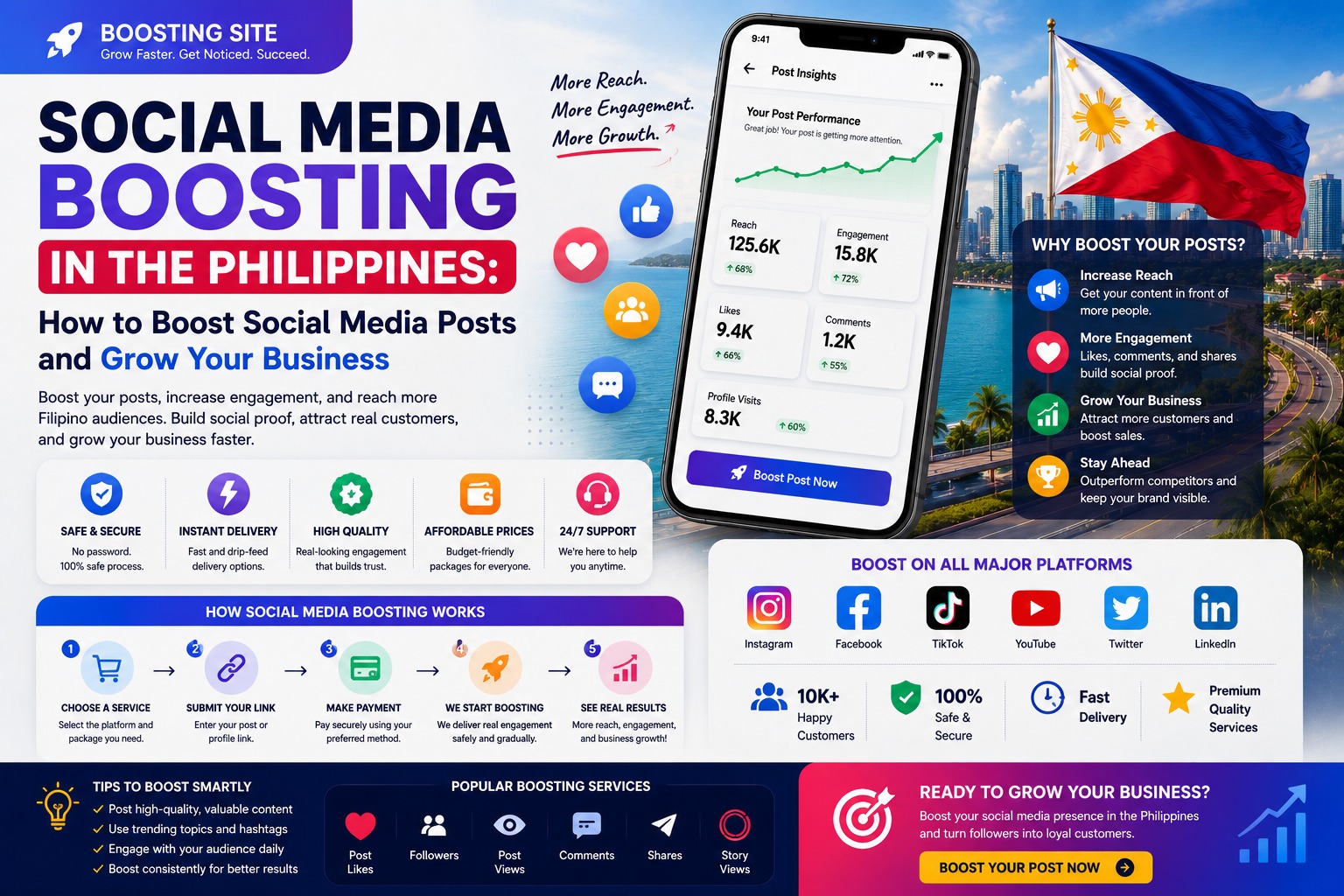
How to Boost Social Media Posts and Grow Your Business?
Social media can put a small Philippine business in front of thousands of potential customers. But publishing a post does not always mean enough people will see it organically. That is where social media boosting can help. Instead of creating an entirely new campaign, you can take an existing post, add a controlled advertising budget, choose a relevant audience, and give that content more opportunities to reach potential customers.
Imagine a small café in Quezon City. Its new ube latte Reel receives positive comments and reactions from existing customers. The owner decides to promote the post to nearby people who may be interested in cafés and food.
That promotion could generate:
- More local awareness
- Profile visits
- Messages
- Website visits
- Orders
It does not guarantee sales. Your offer, pricing, location, customer service, creative, and ordering process still matter. This guide explains how to boost social media posts, how boosted posts work, how they differ from full advertising campaigns, how to choose a budget, and how Philippine businesses can measure meaningful results.
What Is a Boosted Post?
A boosted post is an existing social media post that receives paid distribution. Instead of relying entirely on organic distribution, you pay the platform to show the content to a broader or selected audience.
Depending on the platform, you may be able to choose:
- Campaign goal
- Audience
- Location
- Budget
- Duration
- Call to action
The boosted content usually remains connected to the original post, including its existing image, video, caption, comments, and reactions. The difference is that the platform now distributes it as paid content. A boosted post is therefore a form of social media advertising.
How Do Boosted Posts Work?
The basic process is straightforward.
You usually:
- Select an eligible post.
- Choose a campaign objective.
- Select or create an audience.
- Set a budget.
- Choose how long the promotion should run.
- Review the campaign.
- Submit it for advertising approval.
After approval, the platform begins distributing the content according to the selected campaign settings and its advertising system.
Available objectives differ between platforms and account types.
Depending on the platform, objectives may include:
- Reach
- Engagement
- Profile visits
- Video views
- Messages
- Website traffic
- Leads
- Sales
Choose an objective that matches what the business actually wants. If you need customer enquiries, optimizing only for reactions may not be the most useful approach.
Boosted Post vs. Paid Social Media Ad
A boosted post and a traditional social media ad both involve paying for distribution. The main difference is usually the level of control.
Boosted Post
A boost generally starts with content you have already published.
It usually provides a simpler setup with options such as:
- Objective
- Audience
- Budget
- Duration
- Basic CTA
This can work well for promoting:
- An existing Reel
- Local announcements
- Offers
- Events
- Educational posts
- Product demonstrations
Full Advertising Campaign
A campaign created through an advanced advertising manager may provide greater control over:
- Campaign structure
- Audience segmentation
- Retargeting
- Placements
- Conversion tracking
- Creative variations
- Bidding
- Testing
- Reporting
LinkedIn, for example, distinguishes its simplified post-boosting experience from Campaign Manager, which provides more advanced campaign controls.
Neither approach is automatically better. A restaurant promoting a weekend offer may only need a simple boost. An ecommerce business running nationwide conversion campaigns may benefit from a more advanced advertising setup.
Which Social Media Platforms Support Promotion?
Several major platforms provide simplified paid-promotion tools.
Facebook businesses can promote eligible Page content to expand paid distribution.
This can be useful for:
- Local businesses
- Events
- Offers
- Videos
- Community-focused content
- Customer enquiries
Instagram promotion can work particularly well with visually driven content such as:
- Reels
- Food
- Fashion
- Beauty
- Travel
- Fitness
- Product demonstrations
Use eligible professional-account content and follow the promotion options currently available inside your account.
TikTok
TikTok’s Promote tool allows eligible users to amplify videos, carousel posts, and LIVE content. As of July 2026, TikTok lists Promote objectives covering account growth, leads, website activity, sales, and LIVE promotion. Users can choose an audience, budget, and duration from the Promote experience.
LinkedIn also provides post-boosting options for professional and business content.
It can be useful for:
- B2B services
- Training
- Recruitment
- Professional events
- Thought leadership
Campaign Manager provides additional options when more advanced targeting and campaign management are required.
YouTube
YouTube now provides a simplified Promote tool for eligible videos and Shorts. Businesses and creators can use it to increase video visibility, attract subscribers, or send people to a website. More advanced campaigns can still be managed through Google Ads. Do not use every platform simply because a promotion button exists. Choose the channels where your customers actually spend time.
Why Should You Boost a Social Media Post?
Paid distribution can support several marketing objectives when the content and audience are properly matched.
Increase Post Reach and Visibility
One of the clearest benefits is additional reach. A promoted post can appear in front of people who do not already follow your account.
This can be useful for:
- Product launches
- New services
- Seasonal offers
- Events
- Announcements
- Local promotions
For example, a resort may promote an upcoming long-weekend package before customers finalize travel plans. A restaurant may promote a family offer around a relevant holiday. Reach alone, however, does not prove business success. Also measure what people do after seeing the post.
Reach a More Relevant Audience
Paid promotion can give businesses greater control over who they try to reach.
Depending on the platform, audience settings may include factors such as:
- Location
- Age
- Interests
- Language
- Existing customer relationships
A salon in Makati does not necessarily need nationwide exposure. A local bakery that delivers only within one city should prioritize customers within a practical service area. At the same time, avoid narrowing an audience without evidence.
Use:
- Customer records
- Existing followers
- Website data
- Sales information
- Page analytics
to guide your targeting.
Increase Engagement and Social Proof
More distribution creates additional opportunities for:
- Comments
- Reactions
- Shares
- Saves
- Video views
- Messages
Meaningful conversations can also make an unfamiliar business easier for a new customer to evaluate. However, not every reaction has the same business value. A message from someone asking about availability may matter more than several passive reactions. Pay attention to what people actually say.
Customer questions can reveal:
- Objections
- Missing information
- Pricing concerns
- Delivery questions
- Future content ideas
Generate Website Traffic, Leads, or Sales
Boosted posts can direct people toward:
- Product pages
- Booking forms
- Menus
- Messenger
- Registration pages
- Quotation forms
- Online stores
Make sure the destination matches the advertisement. If your post promotes a specific ₱500 offer, visitors should be able to find that offer easily after clicking. Do not send them to a generic homepage and expect them to search for it. Also make sure the destination works well on mobile devices.
Support Social Media Growth
Paid promotion can introduce new people to your account.
Some may:
- Visit your profile
- Follow
- Save content
- Watch additional videos
- Return later
But follower growth is not guaranteed. Your profile still needs to give visitors a reason to stay.
Before promoting, review:
- Bio
- Profile image
- Contact information
- Location
- Recent posts
- Pinned content
- Website link
- Reviews or proof
Paid reach can create discovery. Organic content helps determine whether that discovery develops into a relationship.
How to Boost a Social Media Post? Step by Step
Boosting should begin with a plan rather than simply pressing a promotion button.
Step 1: Choose the Right Post to Boost
Start with content that has a clear purpose.
Possible candidates include posts that have already generated useful:
- Comments
- Saves
- Shares
- Watch time
- Profile visits
- Website clicks
- Messages
Strong organic performance can be a useful signal, but it is not the only reason to promote something. A new offer, event, or launch may deserve promotion before it has accumulated much organic data.
Avoid boosting posts containing:
- Blurry images
- Broken links
- Outdated prices
- Expired offers
- Spelling errors
- Confusing information
- Unresolved customer complaints
Paid distribution amplifies the message that already exists. Make sure the message is ready first.
Step 2: Define Your Campaign Objective
Choose one primary objective.
Examples include:
- Awareness
- Engagement
- Video views
- Website traffic
- Messages
- Leads
- Bookings
- Sales
Write the goal clearly.
For example:
Generate qualified Messenger enquiries from customers within our service area.
is much more useful than:
Get more attention.
TikTok Promote currently offers goal categories that can include views and profile growth, leads, website activity, sales, and LIVE promotion, depending on eligibility and setup.
Step 3: Select Your Target Audience
Think about who actually needs the offer.
Consider:
- Location
- Age
- Language
- Interests
- Customer status
- Buying behaviour
For local businesses, geographic targeting can be particularly important. A nationwide audience may create unnecessary advertising spend when the business only serves one area. For online businesses, broader targeting may make sense. Use real customer information whenever possible.
Step 4: Set Your Budget and Duration
There is no universal ideal budget for boosting a post. Start with what your business can reasonably test. One way to think about a budget is to work backward from an acceptable result. Suppose a business wants 20 qualified leads and believes it can reasonably afford up to ₱150 per qualified lead.
A simple test estimate would be:
20 × ₱150 = ₱3,000
That does not guarantee 20 leads. It simply gives the campaign a reasoned budget based on the business objective.
Actual performance depends on:
- Audience
- Competition
- Creative
- Offer
- Platform
- Landing page
- Customer response process
Step 5: Create a Clear Call to Action
Tell people what to do next.
Possible CTAs include:
- Send Message
- Book Now
- Shop Now
- Learn More
- Call Now
- Sign Up
Use whichever action matches the campaign. Specific wording is often clearer than generic language.
For example:
Message us to check today’s delivery areas.
gives the customer more direction than:
Check this out.
Step 6: Review and Launch
Before submitting the promotion, check:
- Post
- Audience
- Location
- Budget
- Duration
- CTA
- Destination link
- Prices
- Dates
- Product availability
- Spelling
- Payment information
Also confirm that the content complies with the platform’s advertising rules. Then submit it for review.
How to Choose the Best Post to Boost?
A strong post usually combines a clear message with a useful next step.
Ask:
Would someone who has never heard of this business understand the post quickly?
If not, improve it first.
Posts With Strong Organic Performance
Review content that performs better than your normal baseline. Look beyond likes.
Check:
- Shares
- Saves
- Comments
- Watch time
- Profile visits
- Website clicks
- Messages
Try to identify why the post worked.
Was it:
- The opening?
- Product demonstration?
- Offer?
- Topic?
- Timing?
- Customer problem?
Use the successful pattern again without endlessly copying the same post.
Educational Content
Useful educational content can make strong promoted material.
Examples include:
- Tutorials
- Comparisons
- Checklists
- Explainers
- Demonstrations
- FAQs
A skincare company could explain a simple routine for humid weather. A tax consultant could explain an important filing requirement. A property business could explain what renters should check before signing an agreement. Provide real value before asking for action.
Promotional Posts and Offers
Offers can be promoted effectively when the details are clear.
Include relevant information such as:
- Price
- Validity
- Location
- Inclusions
- Exclusions
- Availability
- Redemption process
Use urgency only when it is genuine. If an offer ends Sunday, say so. Do not create artificial scarcity that damages trust.
Website Traffic Posts
Promote content with a clear reason to click.
Examples include:
- Product pages
- Guides
- Booking pages
- Menus
- Calculators
- Registration forms
- Comparisons
Always test the landing page on mobile before spending money. A broken button can waste an otherwise strong campaign.
Best Practices for Social Media Boosting
Start With a Clear Business Goal
Match the campaign with an outcome.
For example:
Awareness
- Reach
- Impressions
- Relevant video views
Traffic
- Clicks
- Landing-page activity
Leads
- Qualified messages
- Calls
- Form submissions
Sales
- Purchases
- Revenue
- Cost per purchase
A campaign may look successful inside a platform while producing little commercial value. Measure what matters to the business.
Target Relevant Customers
Use evidence to guide targeting.
You may want to separate:
- Existing customers
- Existing followers
- New prospects
- Website visitors
- Previous engagers
where platform tools and applicable privacy rules allow it. Avoid assuming that broader is always better or that narrower is automatically more accurate.
Test.
Use Strong Visuals and Clear Copy
Social advertising is often viewed on a phone.
Use:
- Clear images
- Readable text
- Mobile-friendly layouts
- Useful subtitles
- Simple messaging
Show the product, problem, result, or offer clearly. Natural Filipino or Taglish wording can be appropriate when it matches your actual customers and brand voice.
Optimize the CTA
- Keep one primary action.
- If you want messages, make sure someone is prepared to answer them.
- If you want bookings, make the booking process easy.
- If you want purchases, remove unnecessary checkout friction.
- A CTA should guide rather than confuse.
Test Audiences and Creatives
Structured testing is better than guessing.
For example:
Hook Test
- Version A: Price-focused
- Version B: Problem-focused
Compare:
- Clicks
- Qualified actions
Creative Test
- Version A: Product image
- Version B: Demonstration video
Compare:
- Engagement
- Clicks
- Conversions
Audience Test
- Version A: Nearby customers
- Version B: Wider relevant audience
Compare:
- Cost per result
- Lead quality
Do not change every variable at once if you want to understand what caused the difference.
Monitor and Improve
Review campaigns regularly.
Watch for:
- High reach but little action
- Weak click-through rate
- Rising costs
- Negative responses
- Low-quality enquiries
- Landing-page problems
Avoid reacting emotionally to every short-term fluctuation. Look for meaningful patterns, then make deliberate changes.
Common Boosted Post Mistakes
Boosting Weak Content
A promotion cannot fix confusing content.
Improve the post before paying to amplify it.
Targeting the Wrong Area
A local plumber does not need nationwide impressions.
A Philippine ecommerce business shipping nationwide may.
Match geography to the business.
Choosing the Wrong Objective
Different campaign objectives encourage different types of outcomes.
An engagement-focused campaign may generate reactions.
A traffic campaign may generate clicks.
A lead-focused campaign aims for enquiries.
Choose based on what you actually need.
Ignoring Budget and Duration
Set:
- Spending limit
- Campaign period
- Review point
Do not leave a weak campaign running simply because nobody remembered to review it.
Failing to Track Business Results
Likes do not explain profitability.
Also monitor:
- Clicks
- Messages
- Leads
- Bookings
- Purchases
- Revenue
When some sales happen offline, ask customers how they discovered the business.
Expecting Paid Reach to Replace Organic Content
Paid delivery ends when advertising stops. Organic content can continue helping customers understand the brand.
Maintain:
- Tutorials
- Customer stories
- Helpful answers
- Product demonstrations
- Behind-the-scenes content
- Community interaction
Paid and organic strategies work best when they support each other.
How Much Does It Cost to Boost a Social Media Post?
There is no single standard cost in the Philippines.
Advertising costs can depend on:
- Platform
- Objective
- Audience
- Location
- Competition
- Creative
- Campaign timing
- Placement
- Offer
Do not copy another business’s budget without considering your own economics. Instead, think about what a customer or lead is worth. If one customer generates ₱2,000 in gross profit, a certain acquisition cost may be sustainable. If the average profit is only ₱100, the same acquisition cost may be unacceptable.
Factors That Affect Boosted Post Costs
Possible factors include:
- Audience competition
- Objective
- Creative performance
- Audience overlap
- Seasonality
- Placement
- Frequency
- Product demand
Your full marketing cost may also include:
- Content production
- Design
- Video editing
- Staff time
- Discounts
- Payment processing
- Landing-page work
Do not evaluate only the platform charge.
Daily Budget vs. Lifetime Budget
Daily Budget
Useful for:
- Ongoing or flexible campaigns
Main benefit:
- Easy control over daily spending
Watch:
- Total spend over time
Lifetime Budget
Useful for:
- Events
- Launches
- Limited promotions
Main benefit:
- Defined overall campaign limit
Watch:
- How delivery is distributed across the campaign period
Test Budget
Useful for:
- Learning about an audience or creative
Main benefit:
- Limits early financial exposure
Watch:
- Small samples may not provide enough evidence for strong conclusions
Scaling Budget
Useful for:
- Campaigns already producing acceptable results
Main benefit:
- Opportunity to increase volume
Watch:
- Cost increases
- Audience fatigue
- Operational capacity
How to Measure Boosted Post Performance?
The right metrics depend on your campaign objective.
Reach
Reach measures unique accounts or users exposed to the promotion according to the platform’s definition.
Useful for:
- Awareness
Impressions
Impressions measure total displays. One person may generate more than one impression.
Frequency
A common calculation is:
Frequency = Impressions ÷ Reach
If a campaign generates 15,000 impressions among 10,000 reached accounts:
15,000 ÷ 10,000 = 1.5
That means the average frequency is 1.5.
Engagement
Depending on the platform, engagement may include:
- Reactions
- Comments
- Shares
- Saves
- Other interactions
One possible engagement-rate formula is:
Engagement Rate = (Total Engagements ÷ Reach) × 100
Use the same calculation method when comparing campaigns.
Click-Through Rate
CTR measures how often impressions lead to clicks.
CTR = (Clicks ÷ Impressions) × 100
A low CTR may point to:
- Weak creative
- Poor audience fit
- Unclear messaging
- Weak CTA
A strong CTR with few conversions may suggest a problem after the click.
Leads and Conversions
Define your conversion clearly.
It could be:
- Purchase
- Booking
- Call
- Registration
- Form submission
- Qualified message
Separate raw leads from qualified leads. Ten serious enquiries may be more valuable than one hundred messages from people outside the service area.
Cost Per Result
A simple formula is:
Cost Per Result = Total Campaign Spend ÷ Number of Results
For example:
If you spend ₱3,000 and generate 20 qualified leads:
₱3,000 ÷ 20 = ₱150 per qualified lead
Then compare the result with the value those leads create.
How to Boost Posts on Different Platforms?
How to Boost Facebook Posts?
For an eligible Facebook Page post, use the promotion option available on the post or through Meta’s business tools.
Typically, you will select:
- Goal
- Audience
- Budget
- Duration
- CTA or related campaign options
Before launching, make sure the Page contains accurate:
- Business information
- Opening hours
- Phone number
- Location
- Website
- Messaging options
How to Boost Instagram Posts?
Use an eligible Instagram professional account and select the promotion option available for the post, Reel, or other supported content. Prepare the profile before promotion.
Check:
- Bio
- Contact information
- Recent posts
- Highlights
- Links
- Proof of your work
A paid visitor should quickly understand what the account offers.
How to Promote TikTok Content?
TikTok currently allows Promote campaigns for eligible videos, carousel posts, and LIVE streams.
The setup can include:
- Goal
- Audience
- Budget
- Duration
Current Promote objectives can support goals such as:
- Video views
- Profile views
- Followers
- Leads
- Website activity
- Sales
- LIVE promotion
TikTok also supports deeper Promote integration with TikTok Ads Manager for more advanced campaign capabilities. Use content that feels appropriate for TikTok instead of simply copying a traditional advertisement.
How to Promote YouTube Videos?
YouTube’s Promote feature provides a simplified way to run advertising for eligible videos and Shorts. YouTube says Promote can be used for objectives such as additional visibility, subscribers, and website clicks. Promotions can be created through YouTube Studio, while Google Ads remains available for more advanced campaign controls. Importantly, YouTube states that Promote campaigns do not affect a video’s organic recommendation performance.
How to Boost LinkedIn Content?
LinkedIn provides simplified boosting for eligible content.
Businesses may use it for:
- Brand awareness
- Engagement
- Website visits
- Professional audiences
LinkedIn Campaign Manager provides additional targeting, campaign formats, bidding options, and conversion-focused capabilities when more control is required.
Boosted Posts vs. Organic Social Media Growth
Paid and organic social media serve different purposes.
Benefits of Paid Social Reach
Paid promotion can:
- Extend content beyond existing followers
- Target selected audiences
- Support launches
- Generate measurable traffic
- Test messaging
But additional reach does not guarantee revenue.
Benefits of Organic Content
Organic content helps develop:
- Trust
- Community
- Brand personality
- Customer education
- Long-term content history
Someone discovering your business through an advertisement may visit the profile and browse older posts before deciding what to do next.
That is where organic content becomes important.
Use Paid and Organic Together
A practical strategy can look like this:
- Publish useful organic content.
- Observe what customers respond to.
- Select content with a clear marketing purpose.
- Promote it to an appropriate audience.
- Measure business outcomes.
- Continue publishing useful organic content.
- Improve future campaigns with what you learned.
Paid promotion creates additional opportunities for discovery. Organic content helps build the trust needed after discovery.
Frequently Asked Questions About Boosted Posts
Is Boosting a Social Media Post Worth It?
It can be worthwhile when:
- The post has a clear purpose.
- The audience is relevant.
- The offer is useful.
- The creative is strong.
- The next step is simple.
- Results can be measured.
Start with a controlled test rather than assuming every promoted post will succeed.
Does Boosting a Post Increase Followers?
It can introduce more people to your account, which may lead to additional followers. However, follower growth is not guaranteed. A clear bio, strong content, active profile, and useful information make it easier for visitors to understand why they should follow.
How Long Should I Boost a Post?
There is no universal duration.
It depends on:
- Goal
- Audience
- Budget
- Buying cycle
- Offer
- Event date
- Campaign performance
Set a review point and adjust based on results.
How Much Should I Spend to Boost a Post?
Use an amount your business can afford to test.
Work backward from:
- Desired result
- Acceptable cost per result
- Customer value
- Cash flow
Do not assume a specific peso amount works for every Philippine business.
Can I Stop a Boosted Post Early?
Major advertising platforms generally provide campaign-management controls that allow active promotions to be paused or ended. Always check the current options inside the platform you are using because campaign-management controls may differ. Record why you stopped the campaign so the information can improve future decisions.
What Type of Post Should I Boost?
Strong candidates can include:
- Useful educational content
- Product demonstrations
- High-performing organic posts
- Genuine testimonials
- Offers
- Events
- Website-focused content
Avoid promoting content that is:
- Outdated
- Confusing
- Low quality
- Irrelevant
- Missing a clear purpose
Is a Boosted Post the Same as an Advertisement?
Yes. A boosted post is a form of paid advertising. The main difference is that boosting generally provides a simpler setup built around existing content, while advanced advertising managers offer more detailed campaign controls.
Final Thoughts: Turn Strong Posts Into Growth Opportunities
Learning how to boost social media posts gives Philippine businesses another way to extend the reach of useful content. The process does not need to be complicated.
Start with:
- A strong post
- One clear objective
- A relevant audience
- A manageable budget
- A clear CTA
- Meaningful measurement
Do not boost every post. Choose content with a real purpose.
Test it.
Measure:
- Reach
- Engagement
- Clicks
- Messages
- Leads
- Sales
- Cost per result
Then improve what you learn from the campaign. Most importantly, do not treat paid social media promotion as a replacement for organic content. Continue answering customer questions, creating useful posts, showing real proof, improving your profile, and building relationships with your audience. When the right content reaches the right Filipino audience with a clear next step, social media boosting can become a practical part of a wider business growth strategy.