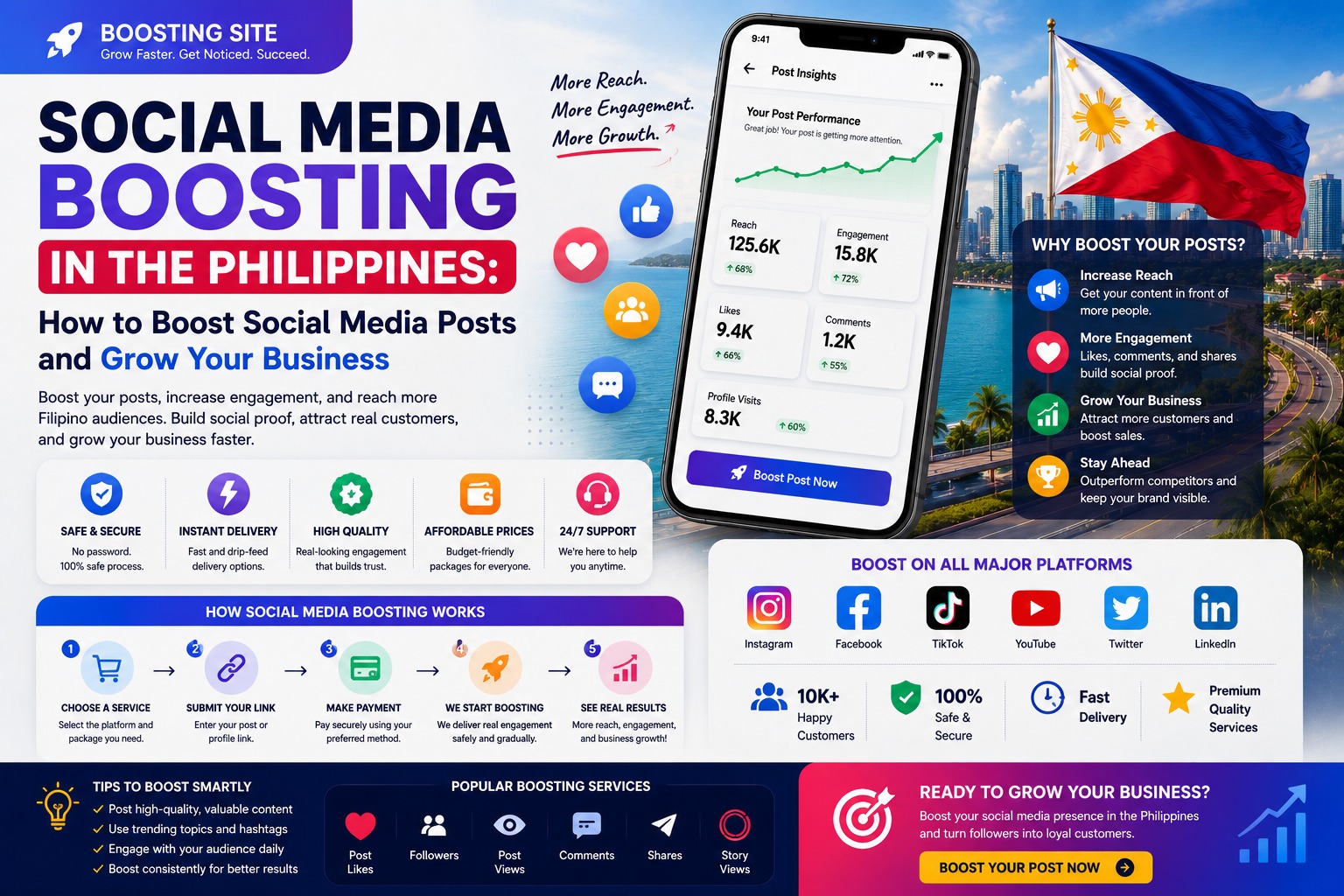
How to Boost Social Media Posts and Grow Your Business?
Social media can put a small Philippine business in front of thousands of people. Yet posting alone doesn’t always deliver enough organic reach. That’s where social media boosting can help. You take a post that already exists, add a controlled budget, choose a relevant audience, and give the content more chances to be seen.
Think of a small café in Quezon City. Its new ube latte post receives good comments from regular customers. The owner then promotes it to nearby coffee drinkers who haven’t discovered the café yet. That simple step may create more visits, messages, and orders. It won’t guarantee sales, though. The offer, location, customer service, and ordering process still matter.
This guide explains how to boost social media posts in clear language. You’ll learn what boosted posts mean, how Facebook and Instagram promotion works, how much to budget in Philippine pesos, and how to measure real results. The advice also applies to many Filipino businesses, including online sellers, restaurants, salons, tutors, clinics, resorts, freelancers, and local service providers.
What Is a Boosted Post?
What is a boosted post? It’s an existing social media post that receives paid distribution. Instead of showing the content mainly to followers, the platform displays it to a selected social media audience. You choose the goal, location, audience, budget, and campaign period.
A boosted post remains connected to its original content. It may include the same image, video, caption, comments, reactions, and shares. The platform simply gives it more exposure through paid reach. This differs from normal distribution, where organic reach depends on followers, sharing, engagement, content quality, and algorithmic decisions.
For example, a Cebu resort might publish a post about a weekend room package. The post can then reach people in Metro Manila who show interest in travel. Meanwhile, a neighborhood bakery in Iloilo may target people living within a few kilometers of its delivery area. Good location settings prevent the bakery from paying for impressions it cannot serve.
How Boosted Posts Work on Social Media?
How boosted posts work is fairly simple. You select an existing post, choose a campaign goal, define the target audience, set the advertising budget, select a duration, and submit the promotion for review. Once approved, the platform enters the campaign into its advertising system.
The system decides which eligible users should see the post. It considers the chosen objective, user behavior, audience relevance, available placements, competing advertisers, and creative quality. A useful post shown to the right people can receive better delivery than a confusing post with the same budget.
A boosted campaign can focus on several outcomes. You might seek more reactions and comments. You might want website visits, Messenger conversations, profile visits, leads, or purchases. Select the outcome that matches your actual business need. If you want customer inquiries, don’t optimize only for likes.
The platform may show the post to followers, non-followers, website visitors, people near a location, or users with selected interests. Available choices depend on the platform, account type, country, post format, and current advertising features.
Boosted Post vs. Paid Social Media Ad
Boosted post vs paid ad often confuses beginners. Both involve paid social media distribution. The main difference involves control, setup, and campaign complexity.
A boost usually starts with an existing post. The setup feels quick and accessible. You choose basic objectives, audience settings, budget, and duration. This works well when you need to promote a local announcement, strong reel, special offer, or useful educational post.
A full advertising campaign usually begins inside a platform’s advertising manager. It can offer more detailed audience groups, placements, retargeting, conversion events, creative variations, testing, and reporting. It suits businesses with established funnels, larger budgets, or more complex marketing objectives.
Setup: Quick and simple vs. more detailed
Starting Content: Usually uses an existing post vs. can use new ad creative
Audience Control: Basic to moderate vs. more advanced
Testing: Limited vs. stronger testing options
Reporting: Basic to moderate vs. more detailed
Best Use: Fast content promotion vs. structured campaigns and sales funnels
The difference between boosted posts and ads doesn’t mean one option always wins. A small Manila restaurant may need a quick Facebook post promotion. An online retailer selling nationwide may need conversion campaigns, retargeting, catalog ads, and deeper tracking.
Which Social Media Platforms Support Boosted Posts?
Facebook and Instagram remain popular choices for Philippine businesses. Facebook boosted posts work well for local communities, events, services, customer questions, and older audiences. Instagram boosted posts often suit reels, food photos, fashion, beauty, travel, fitness, and visually led products.
TikTok also provides promotion options for eligible accounts and content. Its short videos can work well for demonstrations, product discoveries, food reviews, budget finds, tutorials, and behind-the-scenes clips. The content should feel natural on the platform. A stiff advertisement may struggle beside casual creator videos.
LinkedIn can support promotion for professional services, recruitment, training, and business-to-business offers. YouTube may suit detailed reviews, tutorials, property tours, and educational demonstrations. Still, don’t promote everywhere simply because each platform offers paid tools. Go where your potential customers actually spend time.
Before launching, check the latest official platform guidance. Features, account requirements, objectives, payment rules, and placement options can change. Meta’s official resources provide current information about boosting posts and advertising tools.
Why Should You Boost a Social Media Post?
The benefits of boosting posts go beyond getting more views. Paid distribution can support brand awareness, customer discovery, website traffic, inquiries, event attendance, and sales. It can also reveal which messages connect with specific Filipino audiences.
However, boosting doesn’t repair weak content. If the offer seems unclear, the photo looks poor, or the business responds slowly, extra exposure may simply reveal those problems to more people. Paid distribution works best when the content, audience, offer, and next step fit together.
Increase Post Reach and Visibility
The first benefit is simple: promotion can increase post reach. Your content may appear before people who don’t follow your page. This can improve social media visibility during a product launch, seasonal offer, local event, or important announcement.
Timing matters in the Philippines. Payday weekends, Christmas shopping, graduation season, school openings, city fiestas, and major online shopping dates may change customer behavior. A food business might promote a family bundle before a holiday. A resort might advertise a long-weekend package several weeks before bookings fill.
Reach alone doesn’t prove success. A campaign can reach many users without creating action. Check whether the additional visibility leads to profile visits, messages, clicks, bookings, or sales.
Reach a More Relevant Audience
Good audience targeting helps you show content to people who can actually use the offer. A Makati salon may target nearby workers and residents. A tutor in Davao may target parents in selected communities. A Baguio accommodation provider may reach travelers from Metro Manila during cooler months.
Use location carefully. A business that only delivers within one city shouldn’t automatically target the whole Philippines. At the same time, avoid making an audience so narrow that the platform struggles to deliver the campaign.
Ask practical questions before you choose a target audience. Where do customers live? What problem brings them to you? What age groups usually buy? Do they ask questions in Filipino, English, or Taglish? Which product features matter most to them?
Increase Engagement and Social Proof
More distribution can create more social media engagement. Reactions, comments, shares, saves, video views, and messages may strengthen trust. When a new customer sees useful comments under a post, the brand can feel less unfamiliar.
Social proof resembles a busy stall in a public market. People often wonder why others have stopped there. The activity doesn’t guarantee quality, yet it creates curiosity and reassurance.
Still, focus on meaningful interaction. A comment from a likely buyer matters more than a random reaction. Read what people say. Their questions may reveal objections, missing information, or new content ideas. Respond promptly, especially when customers ask about price, delivery, location, schedules, or availability.
Generate Website Traffic, Leads, or Sales
A well-planned campaign can generate traffic from social media. The post may send people to a product page, booking form, menu, registration page, Messenger conversation, or quotation request.
The destination must support the promise in the post. If the caption offers a ₱500 package, the landing page should show that package quickly. Don’t send visitors through a maze of pages. Mobile speed matters because many users browse through phones and mobile data.
Track results with analytics and campaign links. A click is not a sale. A message is not always a qualified lead. Check whether inquiries receive fast replies and whether they become bookings, purchases, or repeat customers.
Support Organic Social Media Growth
Promotion can introduce new users to your profile. Some may follow, save posts, watch more videos, or return later. This can support social media growth when your profile contains useful and trustworthy content.
Before promoting, review your profile. Does the biography explain what you offer? Can people find your location, contact details, hours, reviews, menu, portfolio, or booking link? A boosted post may bring visitors who quickly leave if the account looks inactive.
Keep publishing organic content during paid campaigns. Paid reach gets attention. Consistent content gives people a reason to stay.
How to Boost a Social Media Post Step by Step?
Learning how to promote a social media post requires more than pressing a blue button. You need a clear plan before spending money. Decide what you want, who should respond, what amount you can test, and how you’ll judge the result.
The process varies slightly by platform. Facebook and Instagram often use Meta’s tools. TikTok has its own promotion options. Names and screen layouts can change, so follow the current instructions shown inside your account.
Choose the Right Post to Boost
To boost an existing post, begin with content that has a clear purpose. It might already show strong reactions, comments, saves, shares, watch time, clicks, or messages. Organic response can suggest that the topic and format interest your audience.
Don’t rely on numbers alone. A post may receive many comments from friends while attracting few buyers. Read the comments and inspect the people responding. Do they resemble your customers?
Avoid promoting content with blurry images, broken links, outdated prices, poor spelling, confusing captions, or unresolved complaints. Paid reach acts like a loudspeaker. It makes the message louder, not better.
Define Your Campaign Objective
Choose one main objective. You might want awareness, post engagement, website traffic, messages, leads, bookings, or sales. The platform uses this choice to guide delivery and reporting.
For example, a dental clinic may want appointment inquiries. A restaurant may seek delivery orders. A nonprofit may want event registrations. A creator may want video views. Each goal requires a different measurement.
Write the goal in one sentence. “Generate 25 qualified Messenger inquiries from customers within ten kilometers in seven days” gives you a clearer path than “get more attention.”
Select Your Target Audience
Your social media audience should have a reasonable chance of needing and buying your offer. Consider location, age, language, interests, customer status, and likely purchase timing.
A local business can use city, province, municipality, or radius targeting where available. An online store may target nationwide customers but create separate groups for new prospects and previous visitors.
For how to promote posts to a targeted audience, start with real evidence. Study customer records, page insights, website data, and common questions. Don’t assume every person in a wide age group wants the same thing.
Set Your Budget and Campaign Duration
To set a social media budget, decide what result you want and what that result may be worth. A campaign budget should fit your cash flow and fulfillment capacity.
Suppose you want 20 leads and can afford ₱150 for each qualified lead. A starting test budget could be about ₱3,000. This remains an estimate, not a promise. Your actual result may differ because of competition, creative quality, targeting, and offer strength.
A daily budget works for flexible campaigns and ongoing tests. A lifetime budget works for fixed events, launches, and promotions with a firm end date. Set a review point before launching. Don’t let a weak campaign continue simply because you forgot to pause it.
Create a Strong Call to Action
To create an effective call to action, tell people what to do next. Use “Send Message,” “Book Now,” “Shop Now,” “Learn More,” “Call Now,” or “Sign Up” when those actions match the goal.
Specific language works better than vague wording. “Message us for today’s delivery areas” gives more direction than “Check this out.”
Tell readers what happens after they act. Will someone reply within ten minutes? Will they receive a quotation? Will the page show available dates? Small details reduce uncertainty.
Review and Launch Your Boosted Post
Before launch, check the post, audience, budget, schedule, destination link, payment details, CTA, spelling, dates, prices, and availability. Preview the content on a phone.
A campaign for a sold-out product wastes money and frustrates customers. So does a post that promises free delivery without explaining the service area.
Check advertising rules for restricted products, personal claims, health statements, intellectual property, and misleading offers. Meta publishes current advertising standards through its Business Help Center.
After submission, save the settings. Record the starting date, audience, budget, objective, and creativity. Later, you’ll know what changed.
How to Choose the Best Post to Boost?
The best posts to boost usually contain a clear message and a useful next step. Strong organic engagement helps, yet strategy matters too. A new product launch may deserve promotion even before it gathers much data.
Ask yourself a blunt question: would someone unfamiliar with the business understand this post within a few seconds? If not, revise it first.
Posts With Strong Organic Engagement
Look for posts that outperform your normal results. Check shares, saves, comments, watch time, profile visits, clicks, and messages. A post with fewer reactions may still be valuable if it brings serious inquiries.
Study why it worked. Maybe the opening line addressed a common problem. Perhaps the video showed the product in use. Maybe the timing matched payday or a local event.
Use the successful pattern again. Don’t copy the exact post forever. Familiarity helps, but repetition can make a page feel stale.
Educational and Valuable Content
Tutorials, comparisons, explainers, checklists, and demonstrations often make useful promoted posts. They help people before asking them to buy.
A Philippine skincare brand might explain how to build a routine for hot, humid weather. A tax consultant might explain a filing deadline in simple terms. A property agent might show what first-time renters should check before signing.
Connect the lesson naturally to your service. Don’t hide every useful detail behind a sales form. Trust grows when readers receive value before they spend.
Promotional Posts and Special Offers
Offers can perform well when the value is clear. State the price, validity, location, inclusions, exclusions, stock level, and redemption steps.
Local businesses can promote payday bundles, free-delivery windows, graduation packages, Christmas offers, or limited appointment slots. Make sure your team can handle demand. A successful campaign can create its own headache if orders pile up without enough staff.
Use urgency honestly. “Available until Sunday” works when the offer truly ends Sunday. False scarcity damages trust.
Posts Designed to Generate Website Traffic
Choose posts that give people a reason to click. A useful guide, product comparison, booking page, menu, calculator, quotation form, or registration page can work well.
Send users to a focused landing page. A generic homepage may force them to search for the information promised in the post.
Check the page on a mobile phone. Test the form. Test the payment option. Confirm that tracking records visits and completed actions. One broken button can quietly swallow an entire budget.
Best Practices for Boosting Social Media Posts
The best practices for boosting social media posts begin with customer understanding. You need a useful message, a relevant audience, a realistic budget, and a response system.
Don’t treat a boost like a lottery ticket. It’s a small business experiment. You spend, observe, learn, and improve.
Start With a Clear Marketing Goal
Connect the campaign with a business result. Awareness campaigns need reach and frequency. Traffic campaigns need clicks and landing-page behavior. Lead campaigns need qualified inquiries. Sales campaigns need purchases and revenue.
This keeps social media strategy connected to business reality. A campaign can look successful inside the platform yet fail commercially. For example, many cheap clicks may produce no orders if the landing page lacks prices or payment information.
Target the Right Audience
Use customer evidence to guide ad targeting. Separate existing followers from new prospects when their needs differ. Retarget people who watched a video, visited a page, or interacted with previous content when the platform permits it.
Don’t make the audience too broad. Don’t make it impossibly narrow either. Test a focused group against a larger relevant audience and compare the results.
Use Engaging Visuals and Copy
The opening moment matters. Show the product, problem, result, or offer quickly. Use clear images, readable text, subtitles, and mobile-friendly layouts.
Filipino audiences respond to content that feels useful and familiar. A local face, practical example, or natural Taglish caption may feel more credible than a generic stock image.
Keep the copy easy to scan. Short paragraphs help. A strong first line earns the next few seconds.
Optimize Your Call to Action
Use one main CTA. Tell people exactly what happens next. If you request a message, prepare quick replies. If you request a booking, show available steps. If you request a purchase, make checkout simple.
A good CTA reduces friction. It doesn’t shout. It guides.
Test Different Audiences and Creatives
Test one major variable at a time where possible. Compare locations, age groups, hooks, images, videos, captions, placements, or CTAs.
A simple testing record can help:
Hook: Version A – Price-led | Version B – Problem-led → Main Result: Compare clicks
Creative: Version A – Product photo | Version B – Demonstration video → Main Result: Compare engagement
Audience: Version A – Nearby residents | Version B – Wider city audience → Main Result: Compare cost per result
CTA: Version A – Send Message | Version B – Shop Now → Main Result: Compare actions
Small budgets may not produce perfect certainty. Still, structured testing beats guessing.
Monitor Performance and Adjust Your Campaign
To optimize boosted posts, review performance regularly. Look for high reach with no action, falling CTR, rising costs, negative comments, or repeated complaints.
Change one important element at a time. You might improve the hook, narrow the location, replace the image, adjust the offer, or repair the landing page.
Don’t react to every hourly change. Give the campaign enough delivery to produce useful information. Then act on patterns, not panic.
Common Boosted Post Mistakes to Avoid
Many businesses lose money because they promote before preparing. The post may look attractive to the owner, yet customers may not understand the offer.
Paid distribution can magnify confusion. It can also magnify a broken link, weak customer service, or inaccurate information. Check the customer journey before you launch.
Boosting the Wrong Type of Content
Don’t promote every post. Avoid content with unclear wording, weak visuals, outdated details, or no measurable purpose.
A personal announcement may interest existing followers but fail as a customer acquisition message. A beautiful photo may gain reactions yet provide no reason to visit, message, or buy.
Improve the content first. Promotion should amplify a useful message.
Targeting an Audience That Is Too Broad
A bakery serving one district shouldn’t spend heavily across the entire country. A local plumber doesn’t need impressions from people who live hours away.Broad targeting can work for online products, nationwide services, or awareness campaigns. It doesn’t work automatically for every business.Use delivery areas, customer locations, price range, and actual purchase behavior to guide your choices.
Using an Unclear Campaign Objective
An engagement objective may bring reactions rather than buyers. A traffic objective may bring clicks rather than qualified leads. Choose the outcome you truly want.This doesn’t mean every campaign must generate sales immediately. Awareness has value. Just measure it as awareness.
Ignoring Your Budget and Campaign Duration
Set a spending limit and end date. Create a review point. Decide what result would justify continuing.During Christmas, payday periods, and major shopping events, competition may rise. Your usual cost may change. Plan for that possibility.
Failing to Track Results
Likes rarely explain financial performance. Track clicks, messages, leads, bookings, purchases, revenue, and response time.Ask customers how they found you when platform reporting misses offline or private interactions. Keep a simple record. It may reveal that a campaign created fewer leads but better customers.
Expecting Paid Reach to Replace Organic Growth
Paid reach stops when spending stops. Organic content can continue attracting views, shares, saves, and profile visits.Maintain useful posts, customer stories, behind-the-scenes content, answers, and community interaction. Paid promotion gets attention. Consistency helps earn trust.
How Much Does It Cost to Boost a Social Media Post?
The question how much does it cost to boost a social media post has no single answer. Costs vary by platform, objective, audience, creative, location, timing, competition, and campaign quality.
A small Philippine business might test with a modest daily amount. Another business may need more because its customers are expensive to reach or its sales cycle takes longer. Don’t copy another company’s budget blindly.
Calculate what a result is worth. If one profitable customer generates ₱2,000 in gross profit, a ₱500 acquisition cost may be acceptable. If the customer generates only ₱100, that same cost is unsustainable.
Factors That Affect Boosted Post Costs
Audience competition affects auction prices. Popular cities, commercial interests, property, finance, education, beauty, and holiday shopping may attract many advertisers.
The chosen objective also matters. Impressions, clicks, messages, leads, and purchases require different optimization signals. Creative quality matters too. Relevant content may receive stronger delivery than content users ignore.
Placement, audience overlap, frequency, seasonality, and account history can influence results. Tax, payment processing, currency conversion, creative production, discounts, and staff time also belong in your real budget.
Daily Budget vs. Lifetime Budget
A daily budget sets an average amount for each day. It suits flexible testing or ongoing promotion. A lifetime budget sets a total amount across a defined schedule. It suits launches, events, and fixed offers.
- Daily BudgetBest for: Flexible campaigns
Main Advantage: Easy daily control
Watch Carefully: Total spend over time
- Lifetime BudgetBest for: Fixed campaigns
Main Advantage: Clear overall limit
Watch Carefully: Delivery across the schedule
- Test BudgetBest for: Learning
Main Advantage: Reduces early risk
Watch Carefully: Limited data
- Scaling BudgetBest for: Proven campaigns
Main Advantage: Expands results
Watch Carefully: Rising costs and fatigue
Platform spending can vary by day. Review the actual amount and delivery rather than assuming every day looks identical.
How to Set a Budget for Your Goals?
Start with your desired result. If you need 20 qualified leads and accept ₱150 per lead, a ₱3,000 test gives you a working starting point.
That doesn’t guarantee 20 leads. It gives you a reasoned test. Results depend on the offer, audience, creative, platform, response process, and market conditions.
Reserve part of the budget for a second creative or audience. Scale only when lead quality, customer service, and fulfillment remain strong.
How to Measure the Success of a Boosted Post?
To measure boosted post performance, connect platform data with business records. The right number depends on your goal.You can use the following formula for cost efficiency:Cost per result=Total campaign spendNumber of results\text{Cost per result} = \frac{\text{Total campaign spend}}{\text{Number of results}}Cost per result=Number of resultsTotal campaign spend.For social media ROI, compare the profit or revenue generated with the complete campaign cost. Include creative work, discounts, delivery support, staff time, and platform charges when practical.
Reach and Impressions
Reach counts unique accounts that saw the post. Impressions count total displays. If a campaign reaches 10,000 people and produces 15,000 impressions, average frequency equals 1.5.High reach supports awareness. High frequency may help recall, yet repeated exposure can also cause fatigue. Watch comments, clicks, and negative feedback alongside delivery.
Engagement Rate
To track post engagement, review reactions, comments, shares, saves, video views, profile visits, and messages.
A basic engagement-rate formula is:Engagement rate=Total engagementsReach×100\text{Engagement rate} = \frac{\text{Total engagements}}{\text{Reach}} \times 100Engagement rate=ReachTotal engagements×100.Use the same formula when comparing posts. Platform definitions can differ, so avoid comparing numbers without checking what each one includes.
Click-Through Rate
Click-through rate measures how often impressions produce clicks. A low CTR may indicate a weak hook, poor audience match, unclear offer, or ineffective CTA.Check the landing page after the click. A strong CTR with few conversions may indicate problems with speed, pricing, trust, payment options, or page relevance.
Conversions and Leads
Define a conversion clearly. It might mean a purchase, booking, form submission, call, registration, or qualified Messenger inquiry.Separate total leads from qualified leads. A campaign can generate many messages from people who cannot afford the product or live outside the service area.Track response time, appointment rate, close rate, revenue, and repeat purchases. These numbers show whether the campaign created business value.
Cost Per Result
Cost per result helps you compare campaign efficiency. Calculate it separately for clicks, messages, leads, bookings, and purchases.A cheap click means little if it never produces a sale. A more expensive lead may be valuable when that lead regularly becomes a paying customer.
Review the trend. Rising costs may suggest audience fatigue, stronger competition, a weak offer, or creative wear-out.
Boosted Posts for Different Social Media Platforms
Platform choice should follow customer behavior. A local community service may perform best on Facebook. A clothing brand may gain stronger attention through Instagram reels. A food discovery brand may find TikTok more suitable.The same idea can travel across platforms, yet the format should change. A long Facebook explanation may become a quick TikTok demonstration or an Instagram carousel.
How to Boost Facebook Posts?
For how to boost Facebook posts, open the eligible post on your Facebook Page and select the promotion option. Choose the goal, audience, budget, duration, placement choices, and CTA shown in your account.
Facebook suits community announcements, local services, events, offers, videos, customer questions, and Messenger campaigns. A restaurant in Pasig might target nearby residents. A repair service in Cagayan de Oro might target households within its operating area.Check your Page information before launching. Add accurate hours, phone details, location, services, reviews, and a working message option.
How to Boost Instagram Posts?
For how to boost Instagram posts, use a professional account and follow the promotion option available for the selected feed post, reel, or story.
Strong Instagram promotion often uses vertical video, clear first-frame text, subtitles, natural product demonstrations, and a direct CTA. Food, fashion, beauty, travel, fitness, and events can benefit from visual storytelling.
Make your profile ready. Include a clear biography, service area, contact option, highlights, recent proof, and a working link. A promoted visitor should understand the business quickly.
How to Promote Posts on TikTok?
TikTok promotion works best when the content feels native. Start with movement, a question, a surprising result, a quick demonstration, or a practical tip.
Local examples might include a ₱100 meal discovery, a small-business packing video, a budget travel guide, or a simple beauty tutorial for humid weather.
Watch retention and completion rates. A video may receive many views yet lose viewers during its first seconds. Improve the opening before increasing spend.
Boosting Posts on Other Social Platforms
LinkedIn can support professional audiences. YouTube can support longer educational or product videos. Other platforms may help only when your customers actively use them.
Consider audience presence, creative fit, cost, targeting, and tracking before choosing another channel. A small budget often performs better on one suitable platform than five scattered networks.
Boosted Posts vs. Organic Social Media Growth
The boosted posts vs Facebook ads question usually reflects a wider choice between quick paid distribution and structured advertising. Both differ from organic publishing, which relies on unpaid distribution.Paid promotion offers speed and control. Organic content offers continuing discovery, trust, personality, and community. Neither approach solves every problem alone.
Benefits of Paid Social Reach
Paid social media can extend content beyond followers, target locations, support launches, and produce measurable traffic. It can also help test messages with a defined group.The downside is clear. Spending stops delivery. Poor creativity wastes money. Strong reach doesn’t guarantee revenue. The campaign must connect with a useful customer journey.
Benefits of Organic Content
Organic content builds familiarity over time. Tutorials, customer stories, local updates, reviews, answers, and behind-the-scenes posts help people understand the brand.It also creates a content library. Someone who discovers your page today can browse older posts and decide whether the business seems reliable.
When to Use Paid and Organic Strategies Together?
A practical Facebook and Instagram boosted post strategy starts with regular organic publishing. Observe what people respond to. Then promote selected posts to a relevant audience.Use paid promotion for discovery and organic content for trust. Retarget people who watched, clicked, visited, or engaged. Follow with proof, education, an offer, and a clear reminder.Paid and organic work like a jeepney route and a walking path. One moves people faster. The other helps them reach the final door.
Frequently Asked Questions About Boosted Posts
Is boosting a social media post worth it?
It can be worthwhile when the post has a clear goal, relevant audience, useful offer, strong creative, and measurable result. It may waste money when the page looks inactive, the audience is wrong, or the business cannot respond to inquiries.Start with a controlled test. Compare the value of the result with total cost. Don’t judge success by reach alone.
Does boosting a post increase followers?
It can introduce new users to your profile, but follower growth isn’t guaranteed. People may view one post and leave.A clear biography, strong pinned content, recent posts, useful information, and social proof improve the chance that visitors follow.
How long should I boost a post?
Duration depends on the goal, budget, audience, buying cycle, and timing. A short test may provide early learning. An event campaign needs to end before the event. An awareness campaign may run longer.Set a review date. Pause the campaign when costs rise, the offer ends, frequency becomes excessive, or results weaken.
How much should I spend to boost a post?
Spend an amount you can test without harming cash flow. Work backward from your desired result and acceptable cost.For instance, 20 leads at ₱150 each suggests a ₱3,000 starting estimate. It remains a test, not a guarantee.
Can I stop a boosted post early?
Most platforms allow you to pause or stop promotion before the scheduled end. Some delivery and spending may occur before the change takes effect.
Save the final results. Record why you stopped the campaign. That note can prevent the same mistake later.
What type of post should I boost?
Boost useful educational content, strong organic posts, product demonstrations, testimonials, special offers, event announcements, and traffic-focused posts.Avoid unclear, outdated, blurry, or irrelevant content. What type of social media posts should you boost the question should always connect with your objective.
Is a boosted post the same as an advertisement?
A boosted post is a type of paid advertisement. It usually begins with content already published on your account and offers a simpler setup.
A full ad campaign may provide more control over audiences, placements, creative testing, retargeting, conversion tracking, and reporting. Choose the simpler option for straightforward amplification. Use advanced tools when your funnel needs deeper control.
Conclusion: Turn High-Performing Posts Into Growth Opportunities
Learning how to boost social media posts gives Philippine businesses a practical way to extend useful content. The winning process remains focused: choose the right post, define one objective, select a relevant audience, set a realistic budget, write a clear CTA, and measure meaningful results.
Don’t boost every post. Start with one promising piece of content. Test it with a controlled amount. Watch reach, engagement, clicks, inquiries, sales, and cost per result. Then improve what needs improvement.
A good paid social media strategy doesn’t replace organic content. It supports it. Keep answering customer questions, sharing useful information, showing proof, and building a trustworthy profile.
Your next step can be simple. Review your recent posts, select one with a clear purpose, prepare the audience and budget, and record the results. When the right message meets the right Filipino audience, a small promotion can become a useful growth opportunity.