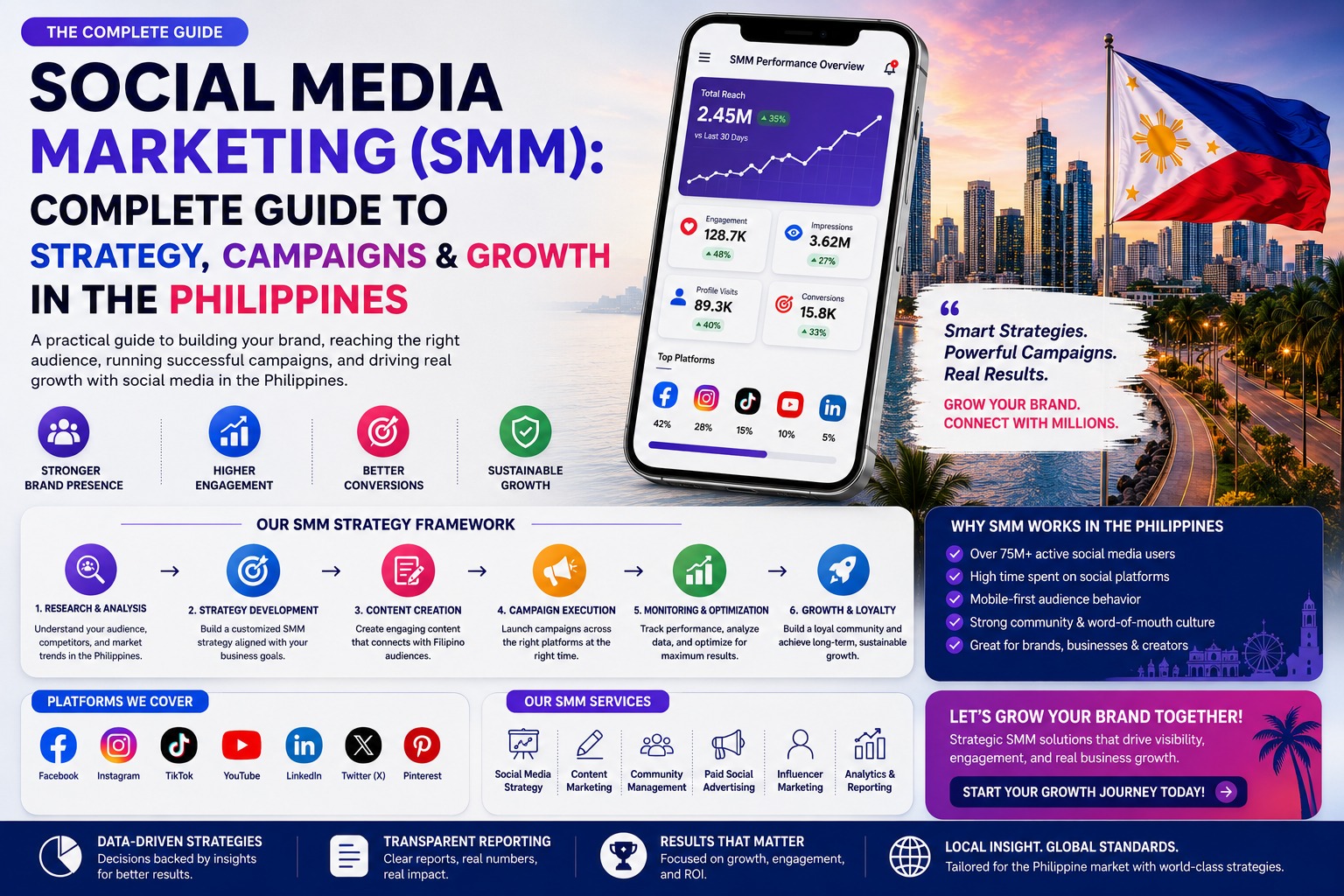
Social Media Marketing (SMM) in the Philippines: Strategy & Growth
Filipinos live online. Not "spend a lot of time" online, live online. By late 2025, the country had 95.8 million social media user identities, which works out to 81.9% of the entire population, and that number climbed by over 9 million in a single year (DataReportal, Digital 2026 Philippines). Whether you're selling home-cooked ube pastillas out of Laguna or scaling a logistics startup in BGC, one thing stays true either way: social media marketing, or SMM, stopped being optional a long time ago. It's the road to your customer now, not a side road.
What follows isn't theory pulled from a Western marketing textbook. It's what actually works for a Filipino audience, the platforms worth your time, the strategy steps that hold up past the first busy month, and the mistakes that quietly bleed small business budgets dry.
What Is Social Media Marketing (SMM)?
Strip away the jargon and social media marketing, or SMM for short, is just this: using platforms like Facebook, Instagram, and TikTok to build your online brand presence, reach your target audience, and turn attention into something you can actually bank. A single product photo posted on a Facebook Page counts. So does a full social media marketing campaign with paid ads and influencer partnerships stacked on top.
Here's what makes SMM different in the Philippine setting, and why copying a foreign playbook usually falls flat. Filipinos don't scroll purely for entertainment. They shop through it. They ask sellers questions through Messenger before ever paying. They read comment sections like reviews. So what is SMM really, in this market? It's closer to running a storefront than running an ad campaign. A sharp social media manager here treats every DM as a possible sale, never just noise to clear out at the end of the day.
How Social Media Marketing Works?
Three things run the whole engine: content, distribution, and timing. You post, the platform's algorithm quietly decides who gets to see it, and paid social media advertising shoves it toward people who don't follow you yet. Organic posts crawl toward your existing audience. Paid promotion sprints toward strangers. That speed gap is exactly why the smartest brands never pick just one lane.
How does social media marketing work for an actual Filipino business, day to day? It starts with knowing when people are awake and scrolling. Evening hours, roughly 7 to 10 PM right after work or school lets out, pull the heaviest traffic, with a smaller bump again at lunchtime. Post during those windows and your reach and impressions jump. Post at 10 AM on a random Tuesday and, well, don't expect much.
Why Social Media Marketing Matters for Businesses?
Your competitors are already there. So are your customers. Skip SMM and you hand over visibility to whichever business next door actually bothers showing up. For small businesses, it's usually the cheapest, fastest route to brand awareness and real sales, cheaper by far than TV or print, which most local shops couldn't afford anyway.
Organic Social Media Marketing vs Paid Social Media Marketing
Organic social media marketing costs nothing upfront. It runs on your social media strategy, your content, and the followers you've already earned. Paid social media marketing flips that entirely: money buys you reach among people who've never heard of you. Neither wins outright. They solve different problems.
Most fast-growing Filipino brands do something specific, actually: build a loyal following organically first, slowly, then layer paid social media advertising on top during launches or big seasonal moments like 11.11 and 12.12, when the whole country's engagement spikes at once. Trying to skip straight to paid ads without any organic trust underneath usually burns money fast.
- CostOrganic SMM: Free, but requires significant time and effort.
Paid SMM: Requires an advertising budget.
- Speed of ResultsOrganic SMM: Slow; typically builds results over months.
Paid SMM: Fast; results can appear within days.
- Best ForOrganic SMM: Building trust, loyalty, and a strong brand voice.
Paid SMM: Increasing sales, reach, and promoting launches.
- TargetingOrganic SMM: Limited mainly to followers and people reached through shares.
Paid SMM: Allows precise demographic and audience targeting.
- Example in the PhilippinesOrganic SMM: Posting regular updates on a Facebook Page.
Paid SMM: Running boosted posts during major shopping events such as 11.11.
Social Media Marketing vs Social Media Management
These two get confused constantly, but they're not the same role. Marketing is strategy: setting marketing objectives, planning campaigns, measuring marketing ROI. Management is the grind underneath it, posting daily, replying to messages, moderating comments, keeping a posting schedule alive even on the days you don't feel like it.
In most small Philippine businesses, one person ends up doing both. Hiring separate specialists just isn't realistic on a startup budget. Bigger companies split it, a strategist calling the shots, a social media manager handling day-to-day content scheduling. Knowing the difference saves you from hiring the wrong person for the wrong job.
Why Social Media Marketing Is Important?
Here's where it gets concrete. Below are the specific ways SMM affects your bottom line, not vague benefits, actual reasons Filipino businesses keep spending time and money on their social channels year after year.
Build Brand Awareness and Online Visibility
Every glimpse of your logo on someone's feed is a small deposit. Nobody buys from a brand they've never seen before. Post consistently, and when the need finally hits, your name is the one that surfaces first.
Connect With Your Target Audience
Comments talk back. Billboards don't. That's the whole edge social platforms hold over traditional ads when it comes to reaching a target audience and building meaningful connections, especially with Filipino buyers, who genuinely want to feel close to the brands they choose.
Generate Leads and Increase Conversions
A well-run social media marketing campaign has a job, and it isn't just to entertain. It exists to generate leads and push conversions. Sometimes that's as simple as "Message us to order" sitting under a good photo. That one line does more work than people expect.
Strengthen Customer Relationships
Reply fast to a complaint or a random question, and Filipino customers notice immediately. That's two-way communication doing its job. Small effort, but it builds customer loyalty that outlasts whatever single sale started the conversation.
Monitor Competitors and Industry Trends
Ten minutes scrolling a competitor's page tells you more than any paid report sometimes. What content lands. What they charge. Where they're leaving gaps wide open for you to walk right into.
Collect Audience Insights and Customer Data
Every like, comment, and share is a tiny data point. Run enough of them through social media analytics and a pattern shows up, real audience insights built on actual customer behavior, not a guess made over coffee.
Best Social Media Platforms for Marketing
Trying to be everywhere at once is one of the fastest ways to waste a marketing budget. Facebook still leads by a mile in this country, 95.8 million users, roughly 97.7% of all Filipino internet users active on it (GMA News, Digital 2026 report). TikTok comes next at around 64 million, YouTube close behind at roughly 59.6 million (Elite Asia, Digital Trends PH 2026).
Which platforms actually deserve your budget depends on your target market and what your content is naturally good at. A restaurant probably thrives on Instagram and TikTok. A B2B logistics company gets more out of LinkedIn and Facebook instead. Test small before you commit your full ad spend anywhere, because no single platform performs the same across every niche.
- Reach and Impressions: How many people saw the content. It shows visibility and top-of-funnel awareness.
- Follower Growth: Tracks new followers over time and signals long-term audience building.
- Engagement Rate: Measures likes, comments, and shares compared with reach. It reflects content quality and audience interest.
- Website Traffic: Tracks visitors arriving from social media and measures how effectively social channels drive traffic to the website.
- Click-Through Rate (CTR): Measures the percentage of people who click a link or ad. It reflects how compelling the CTA is.
- Leads and Conversions: Tracks inquiries, sign-ups, or sales generated through social media and shows the direct business impact.
- Return on Ad Spend (ROAS): Measures revenue generated for every peso spent on advertising. It's a key profitability metric for paid campaigns.
- Customer Acquisition Cost (CAC): Measures how much it costs to acquire one new customer and helps evaluate overall marketing efficiency.
Facebook Marketing
Teenagers use it. Their lolas and lolos use it too. That's the reach Facebook marketing commands here, and Marketplace plus Groups have quietly become full e-commerce hubs for sellers who never bothered building a real website.
Instagram Marketing
Younger, urban, visual-first, that's Instagram's crowd. Instagram marketing rewards good photography, and Reels now beat static posts on engagement rate by a wide margin. If your product looks good on camera, this is its stage.
TikTok Marketing
Over 40 hours a month, that's how long Filipinos spend on TikTok alone (Spiralytics, PH 2026 Facts). Add TikTok Shop and TikTok marketing turns into a real social commerce engine, not just a place to go viral for fun.
YouTube Marketing
Trust builds slower here, but it sticks. YouTube marketing suits tutorials, reviews, longer storytelling, backed by the fact that over 97% of Filipino internet users aged 16 to 64 watch video weekly (Meltwater, PH Social Stats 2026).
LinkedIn Marketing
B2B companies, recruiters, professional service firms find their audience here. LinkedIn marketing also reaches overseas Filipino professionals eyeing opportunities back home, a group other platforms mostly miss.
X Marketing
Fast-moving, real-time, occasionally chaotic. X marketing earns its keep in customer service, breaking news, and jumping into trending conversations while they're still hot.
Pinterest Marketing
Small but devoted audience. Wedding planners, interior designers, food bloggers pull steady inspiration traffic from it, even if it never dominates a Filipino brand's overall strategy.
Snapchat Marketing
Limited traction here compared to TikTok and Instagram. Most brands park zero budget on it unless they're chasing an extremely specific niche.
WhatsApp Marketing
WhatsApp marketing matters most for businesses reaching overseas Filipino workers and their families, since it's still the preferred app for international communication in a way local apps just aren't.
How to Create a Social Media Marketing Strategy?
A social media strategy is your roadmap. Skip it, and you're posting at random, hoping something sticks, burning time and money on guesswork. Building one doesn't need to be complicated. It needs to be intentional, from a clear starting direction down to a real system for measuring whether any of it worked.
Ten steps, and skipping any one of them tends to show up as a weak spot later.
- Define Your Business Goals — Brand awareness, leads, sales, or all three? The answer changes everything downstream.
- Identify Your Target Audience — Age, location, income, interests, all within the Filipino market you're actually selling to.
- Create Detailed Buyer Personas — Real buyer personas, built around actual customer preferences and daily habits, not guesses.
- Research Your Competitors — What do similar brands post, how often, and what earns the strongest engagement rate?
- Choose the Right Social Media Channels — Go where your target market actually spends time, not where you personally enjoy scrolling.
- Develop Your Brand Voice and Messaging — One consistent tone for brand messaging, playful or formal, but consistent either way.
- Plan Your Social Media Content — Map out social media content themes ahead of time so you're never scrambling for ideas at 9 PM.
- Build a Consistent Posting Schedule — A posting schedule your audience can set their watch to builds trust faster than sporadic bursts.
- Set Social Media KPIs — Decide what success looks like before you start, not after.
- Measure Results and Improve Your Strategy — Review performance tracking data regularly, and actually act on what it says.
How to Build a Successful Social Media Marketing Campaign?
A social media marketing campaign carries a specific goal, timeline, and budget attached to it, unlike everyday posting. Think product launch, holiday sale, an anniversary push. More planning upfront, but more concentrated, trackable results on the back end.
Set clear objectives first, define your audience, then pick platforms that actually match the goal. Build a content calendar so nothing falls through the cracks. Layer in social media advertising to reach beyond your existing followers, and push for participation through comments, shares, contests, whatever fits the brand. Once it's live, track campaign performance in real time.
Small mid-campaign tweaks have saved plenty of underperforming launches, but only when someone actually catches the warning signs early enough to act.
Social Media Content Strategy
Content is the fuel. Without decent social media content, even a well-planned campaign falls flat no matter how much budget sits behind it. Filipino audiences respond to content that feels genuine and locally rooted, not something translated word-for-word from an American ad.
Good content marketing mixes variety with consistency, educational posts, entertaining videos, promotional content, all in rotation. A feed that's constant sales pitch pushes followers away faster than almost anything else you could do wrong.
Types of Social Media Content That Drive Engagement
Educational content builds authority quietly, over time, by teaching your audience something they didn't already know. Short-form video, especially Reels and TikToks, currently pulls the strongest organic reach across nearly every platform. User-generated content builds trust in a way ads never quite manage, because people trust other people more than they trust brands. Stories, Reels, live video add urgency, that real-time feel a static post simply can't fake.
Promotional content still earns its place, just not the only place. Evergreen content, the kind still useful a year from now, gives your page long-term value that chasing trends never delivers on its own. Trending content, handled fast and tastefully, occasionally introduces your brand to thousands of new people overnight, assuming you catch the wave while it's still rising.
How to Increase Social Media Engagement?
Social media engagement doesn't happen on its own. It grows out of giving your audience something they actually want, then showing up when they respond. Plenty of Filipino brands post like clockwork and completely ignore their comment section, which is an easy win left sitting on the table.
Reply fast, and people notice a real human runs the page, not a bot on autopilot. Polls and questions invite participation instead of passive scrolling. User-generated content turns customers into brand ambassadors without you asking twice.
Post during Filipino evening peak hours and your content lands in front of far more eyes than a random morning post ever will. Build an active community, through a Facebook Group or just consistent replies, and casual followers eventually turn into people who defend your brand unprompted.
Social Media Marketing Metrics and KPIs
You can't improve what you refuse to measure. Social media metrics tell you whether the effort's paying off or just filling a calendar with busywork. Tracking the right key performance indicators is really what separates steady growth from guesswork dressed up as strategy.
- Reach and ImpressionsWhat it measures: How many people saw the content.
Why it matters: Shows visibility and top-of-funnel awareness.
- Follower GrowthWhat it measures: New followers gained over time.
Why it matters: Signals long-term audience building.
- Engagement RateWhat it measures: Likes, comments, and shares compared with reach.
Why it matters: Reflects content quality and audience interest.
- Website TrafficWhat it measures: Visitors arriving from social media.
Why it matters: Measures how effectively social media drives traffic to the website.
- Click-Through Rate (CTR)What it measures: Percentage of people clicking a link or ad.
Why it matters: Reflects how compelling the CTA is.
- Leads and ConversionsWhat it measures: Inquiries, sign-ups, or sales generated.
Why it matters: Shows the direct business impact of social media.
- Return on Ad Spend (ROAS)What it measures: Revenue generated per peso spent on advertising.
Why it matters: Acts as a core profitability measure for paid campaigns.
- Customer Acquisition Cost (CAC)What it measures: Cost to gain one new customer.
Why it matters: Helps judge overall marketing efficiency.
How to Measure Social Media Marketing ROI?
The formula's simple: subtract total campaign cost from revenue generated, then divide by the cost again. A Php 10,000 ad campaign that generates Php 40,000 in sales sits at 300% ROI, three pesos back for every peso spent. Review this regularly. It tells you exactly where to keep pouring money and where to quietly pull back.
Social Media Marketing Tools
Right tools, less wasted time. Social media management tools cut hours off scheduling, reporting, and audience research every single week. Solo seller or full marketing team, doesn't matter, automating the repetitive parts frees up energy for the work that actually needs a human brain behind it.
Meta Business Suite and Hootsuite run multiple pages from one dashboard instead of five open tabs. Later and Buffer handle scheduling weeks out. Native social media analytics through Facebook and Instagram Insights show exactly what's working and what's dead weight. Social listening tools track mentions across the web. Meta Ads Manager runs the paid side. Canva covers design without hiring anyone. A decent CRM keeps leads from slipping through the cracks once they come in through social.
How to Measure and Improve Social Media Performance?
Growth rarely happens by accident. It comes from regular review, and honest, sometimes uncomfortable, adjustment. A social media audit looks at what's working and what's quietly failing across every channel, giving you a real starting point before touching anything.
Start with audience demographics, just to confirm the right people are actually seeing this. Compare platforms to see where the energy pays off. Dig into your best-performing content to spot what your audience genuinely wants more of. Test different formats, carousels, short video, whatever, since fresh formats surface opportunities you'd otherwise miss entirely. Review the disappointing campaigns honestly too; they teach more than the wins usually do. Then adjust the social media strategy based on what the numbers actually say.
Social Media Marketing Trends to Watch
One SMM approach doesn't fit every business, and trends shift fast enough that last year's playbook is already dated in places.TikTok and Instagram Reels still lead short-form video, no signs of slowing. Social commerce keeps reshaping how Filipinos buy, shopping straight through TikTok Shop and Facebook Shops without leaving the feed. Micro-influencers keep gaining ground over traditional celebrities, since audiences here trust them more. AI now assists with captions and content ideas, though a human still needs to check everything before it goes live.
Personalized content, matched to actual audience demographics and customer preferences, keeps beating generic posts. Social search is rising too, younger Filipinos now search restaurants and products directly on TikTok instead of Google. Community-led marketing, built on genuine community building rather than one-way broadcasting, keeps gaining traction, and the sharpest brands are already testing whatever platform comes next, ahead of the mainstream curve.
Common Social Media Marketing Mistakes to Avoid
Even well-meaning businesses fall into the same traps. Here's what quietly slows growth down.Targeting the wrong audience wastes ad spend on people who were never going to buy anyway. Posting without a strategy leads to messaging so inconsistent it confuses the customers you're trying to win over. Using every platform without a purpose spreads a team thin, weak content everywhere instead of strong content somewhere.
Promotional-only content pushes followers away fast, nobody sticks around for a nonstop sales pitch. Ignoring customer feedback, good or bad, quietly erodes trust over time. Failing to track performance means repeating the same mistakes without ever noticing. And inconsistent publishing tells both algorithms and audiences the same thing: they can't rely on this brand.
Social Media Marketing for Different Business Goals
Goals shape strategy more than industry ever does. A brand chasing brand awareness looks nothing like one focused purely on closing sales this week.
Chasing awareness means wide reach, shareable content, a visual identity that stays consistent everywhere. Chasing leads means clear calls-to-action and capture forms linked straight from posts and bios. E-commerce leans on social commerce features and genuinely good product photography.
B2B businesses do better building credibility on LinkedIn through thought-leadership content over time. Local businesses thrive with location tags and community-focused Facebook Groups. Small businesses, meanwhile, usually win by going deep on one or two platforms instead of spreading thin across everything at once.
How to Learn Social Media Marketing?
This never really stops, since platforms and algorithms shift constantly, sometimes overnight. Plenty of accessible resources exist either way, whether you're brand new to this or years in.HubSpot Academy, Meta Blueprint, and Google Digital Garage all offer free, structured courses worth working through.
Books on digital marketing fundamentals fill in the theory that quick tips usually skip. DataReportal and Meltwater keep you current on Philippine-specific trends instead of only global numbers that don't quite match local behavior. But testing a small campaign yourself, with a modest budget, often teaches more in a month than any course manages in three.
Frequently Asked Questions About Social Media Marketing
What Is Social Media Marketing? Using social platforms to promote a brand, connect with audiences, and drive measurable results, through organic content and paid advertising working together.
What Are the Benefits of Social Media Marketing? Stronger brand awareness, better customer engagement, more leads and conversions, deeper customer relationships, and audience insights that are hard to get this cheaply anywhere else.
Which Social Media Platform Is Best for Marketing? Depends on the business. Facebook wins on raw numbers in the Philippines, though TikTok and Instagram often pull higher engagement from younger, visual audiences.
How Do I Create a Social Media Marketing Strategy? Goals first, then target audience, then platforms, then content, then KPIs you'll actually check later. Skip a step and the whole thing gets shaky fast.
How Much Does Social Media Marketing Cost? Purely organic can cost nothing but time. Paid ads and professional management can run several thousand pesos a month, depending on business size and goals.
How Often Should a Business Post on Social Media? Three to five times weekly works for most Philippine businesses. Consistency beats volume, don't burn out chasing a daily quota just to hit a number.
What Are the Most Important Social Media Marketing KPIs? Engagement rate, reach, conversions, return on ad spend, since these connect directly to real outcomes instead of vanity numbers.
How Long Does It Take to See Social Media Marketing Results? Organic growth usually needs three to six months before it feels meaningful. Paid campaigns move faster, sometimes showing results within days.
Start Building Your Social Media Marketing Strategy
SMM isn't a one-time project. It's an ongoing relationship with the Filipino audience a brand serves. Define goals and audience clearly, pick platforms that match where customers actually spend time, and commit to content worth someone's attention, not whatever trend happened to be loudest this week.
Track results, stay willing to adjust, and remember the businesses winning at this today didn't necessarily have bigger budgets. They just showed up consistently and actually listened. Start small if needed, but start now, because every day without a clear strategy hands a competitor another shot at reaching the same customer first.