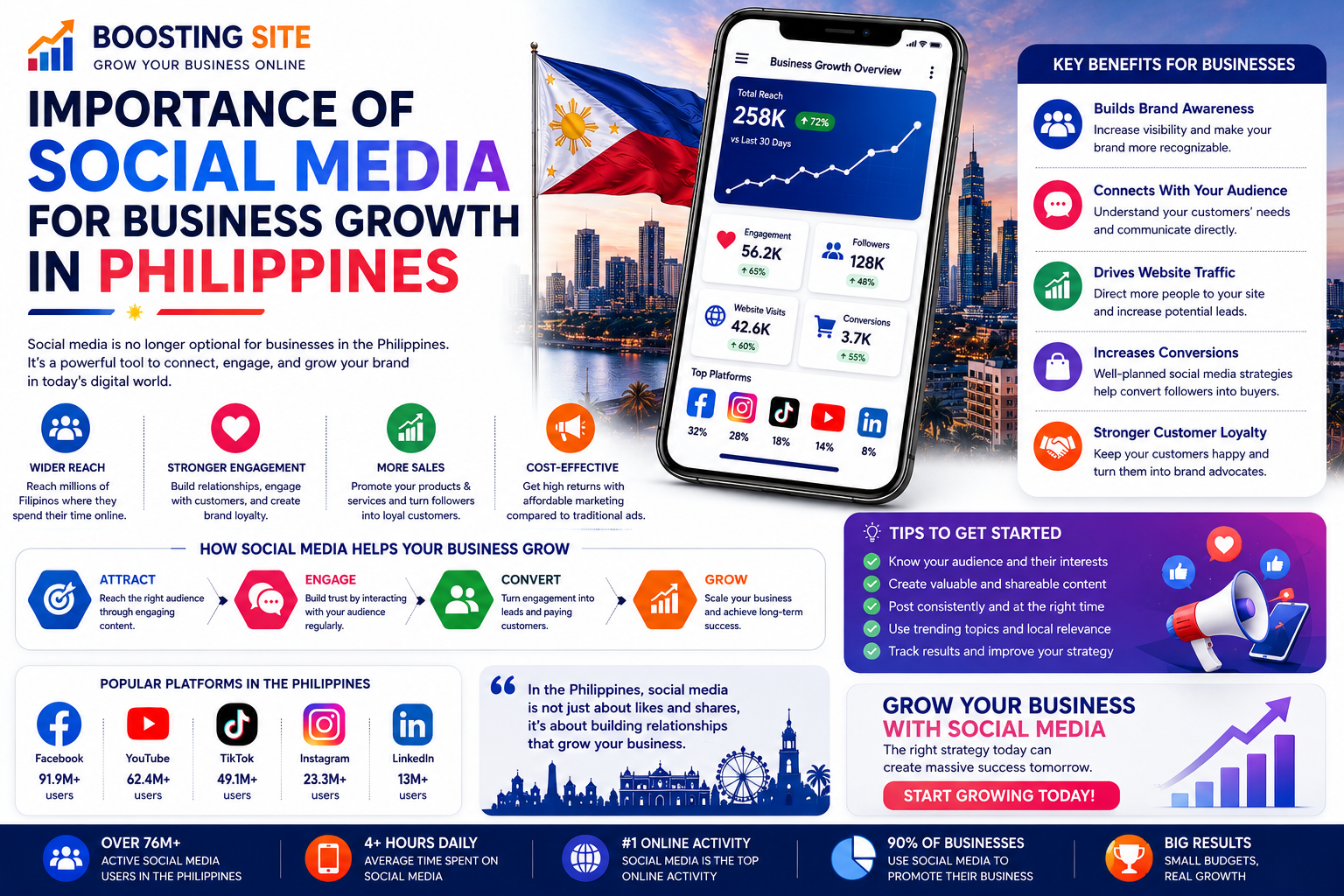
Importance of Social Media for Business Growth in 2026: What Every Filipino Business Owner Needs to Know
Social media has become part of everyday business in the Philippines. For many business owners, running a company now also means replying to Messenger enquiries, answering comments, publishing Reels, sharing product updates, and communicating with customers online. Filipino consumers use social platforms to discover brands, compare products, watch reviews, ask questions, contact businesses, and make buying decisions.
That is why understanding the importance of social media for business growth is no longer only about gaining followers. It is about using social platforms to build visibility, customer relationships, trust, leads, and sales. DataReportal’s Digital 2026 Philippines report estimates that the country had 98 million internet users and 95.8 million social media user identities in late 2025. Social media user identities were equivalent to 81.9% of the total population. DataReportal cautions that these identities should not automatically be interpreted as 95.8 million unique individuals.
For Philippine businesses, that represents a large digital audience already spending time on platforms where brands can communicate with them. But simply creating an account and posting occasionally is not enough. A successful social media presence needs clear goals, relevant content, the right platforms, regular customer interaction, and performance measurement.
Why Is Social Media Important for Businesses?
Social media gives businesses direct access to people who may already be looking for products, services, recommendations, or solutions. DataReportal reports that the Philippines had 137 million cellular mobile connections, 98 million internet users, and 95.8 million social media user identities in late 2025. It also estimates that 97.7% of the country’s internet-user base used at least one social platform.
That means social platforms can play a role throughout the customer journey. Someone might first discover a restaurant through a Reel, research it through Facebook reviews, ask a question through Messenger, and later place an order. Another customer might discover a clothing brand through a creator, visit its Instagram profile, browse its products, and eventually purchase.
For businesses, the value is not simply having a social account. The value comes from being visible and useful when potential customers are already searching, scrolling, comparing, and deciding.
Social Media Usage in the Philippines
The Philippine social media market is large, but platform statistics should be interpreted carefully. Different companies report different types of figures. Some represent potential advertising reach, TikTok may report adult advertising audiences, and LinkedIn reports registered members. According to DataReportal’s Digital 2026 Philippines report, Facebook had potential advertising reach of approximately 95.8 million in late 2025, while Instagram had approximately 26.9 million.
YouTube’s reported potential advertising audience was approximately 59.6 million, while TikTok’s advertising resources indicated approximately 64 million users aged 18 and above in the Philippines. LinkedIn reported approximately 22 million registered members. These numbers should not be directly compared as if every platform measures active users in exactly the same way. The broader point is more useful: Filipino businesses can reach large audiences across several different platforms, but the right platform depends on the customer and business model.
Social Media Growth in the Philippines
DataReportal estimates that social media user identities in the Philippines increased by approximately 9 million, or 10.3%, between late 2024 and late 2025.
However, the report also advises caution when comparing year-to-year figures because changes in source data and measurement methodology can affect reported growth.
Businesses should therefore focus less on one headline number and more on what the overall trend shows: social media remains a major part of the Philippine digital environment.
12 Benefits of Social Media for Business
Social media can support businesses in many different ways. The most important benefits go far beyond followers and likes.
1. Build Brand Awareness
- Social media gives a business repeated opportunities to appear in front of potential customers.
- A person may discover your company through a Reel, shared post, creator recommendation, search result, or advertisement.
- The first interaction may not create a sale.
- But repeated useful exposure can gradually make the business more recognizable.
- For example, a local bakery that consistently publishes new products, customer favourites, behind-the-scenes videos, and useful information becomes easier for local customers to remember.
- Brand awareness usually develops through consistency and relevance rather than depending on one viral post.
2. Reach New Audiences
- Your existing customers are not the only people who can see social content.
- Platforms can introduce content to new audiences through recommendations, search, sharing, creator collaborations, and paid advertising.
- This allows even a relatively small business to communicate beyond its existing customer base.
- The goal should not simply be maximum reach.
- It should be relevant reach.
- A local service business in Cebu benefits more from reaching potential customers in its service area than from receiving thousands of views from people who can never purchase.
3. Increase Customer Engagement
- Traditional advertising mostly communicates in one direction.
- Social media creates conversation.
- Customers can comment, ask questions, send messages, share opinions, participate in polls, and respond directly to the business.
- These interactions can strengthen customer relationships while also providing valuable information.
- Repeated questions may reveal something customers do not understand.
- Comments may reveal new product ideas.
- Complaints may highlight areas that need improvement.
- Social media engagement is therefore not only a number in an analytics dashboard.
- It can also function as customer research.
4. Drive Website Traffic
Social platforms can help move customers toward digital channels that the business controls. A business can direct social visitors toward product pages, service pages, booking systems, blog articles, contact forms, or an online store. Clear calls to action make the next step easier.
For example:
Explore the full collection on our website.
or:
Book your appointment through the link in our profile.
Use tracked links whenever possible. This allows you to see whether Facebook, Instagram, YouTube, or another platform is actually generating valuable website traffic rather than relying on assumptions.
5. Build Customer Trust
Customers often research an unfamiliar company before purchasing. A social profile can help them evaluate the business through customer reviews, useful posts, product demonstrations, comments, testimonials, and how the company responds to questions. Trust does not come from follower count alone.
An account with genuine customer interactions and clear information may create more confidence than a larger account with little meaningful activity. Social media gives businesses an opportunity to show what happens behind the brand rather than asking customers to trust promotional claims alone.
6. Generate Leads and Sales
Social media can support measurable business actions. Depending on the business, that action may be a purchase, message, booking, quotation request, phone call, registration, or completed lead form. A clear call to action helps move the customer forward. Instead of ending every post without direction, tell interested customers what they can do next.
For example:
- Message us for availability.
- Book your consultation.
- View the product online.
- Request a quotation.
Paid social advertising can also expand the audience when the business has a clear offer, appropriate targeting, and an objective that can be measured.
7. Support Social Commerce
Social commerce brings product discovery and purchasing closer together. TikTok Shop is currently available in the Philippines. TikTok’s Seller Center allows eligible businesses to manage ecommerce operations directly through TikTok, while TikTok Shop can present products through in-feed videos, LIVE videos, and Showcase. This can shorten the journey between seeing a product and exploring or purchasing it.
Social commerce can be particularly useful for businesses selling products that work well with visual demonstrations, creator content, livestreams, reviews, and short-form videos. The important point is not simply adding products to a platform. Businesses still need useful content and a clear purchasing experience.
8. Create Flexible Advertising Campaigns
Social advertising provides businesses with control over factors such as audience, location, objective, budget, creative, and campaign duration. This makes it possible for a small local business and a national brand to use the same advertising platform in completely different ways. A business can begin with a budget appropriate for its situation, measure results, and adjust future spending based on performance. Social advertising should not automatically be described as cheaper than every traditional marketing channel. Its main advantages are flexibility, targeting, testing, and measurable campaign data.
9. Showcase Your Brand Personality
- Social media gives businesses more opportunities to communicate like real organizations rather than anonymous companies.
- A restaurant can introduce its kitchen team.
- A clothing company can show how orders are packed.
- A design agency can show part of its creative process.
- A small business owner can explain why a product was created.
- Behind-the-scenes content, staff introductions, customer stories, and genuine brand humour can help customers understand the people and personality behind the company.
- That can make the brand easier to remember.
10. Work With Creators and Influencers
- Influencer marketing can introduce a business to an audience that already follows a creator.
- The best partnership is not necessarily with the creator who has the highest follower count.
- Businesses should consider audience relevance, location, content style, engagement quality, brand fit, and previous collaborations.
- A smaller local creator whose audience closely matches your customers may provide more useful exposure than a much larger account with an unrelated audience.
- Influencer marketing works best when the creator and product genuinely fit together.
11. Understand Trends and Customer Interests
- Social platforms contain continuous conversations about products, industries, problems, interests, and current topics.
- Businesses can use these conversations to identify questions customers repeatedly ask, emerging content formats, common complaints, competitor positioning, and changing interests.
- That does not mean copying every viral trend.
- Before participating, ask whether the topic matters to your customers and whether your business can contribute something useful.
- Trends should support the strategy rather than control it.
12. Improve Customer Service and Retention
- Social media is also a customer communication channel.
- Customers may use Messenger, direct messages, comments, or other digital channels to ask about products, availability, bookings, orders, or support.
- Helpful communication can improve the overall customer experience.
- Social media also allows businesses to stay connected after the first sale through educational content, announcements, communities, customer stories, and relevant offers.
- The customer relationship does not need to end after checkout.
How Social Media Supports the Customer Journey
Social media can influence several stages of the buying journey.
Awareness
The customer first discovers the business through content, advertising, search, a creator, a recommendation, or a shared post.
Consideration
The customer begins evaluating the business. They may review the profile, comments, product videos, customer experiences, FAQs, or reviews.
Conversion
The customer takes the desired action, such as visiting the website, sending a message, booking, registering, or purchasing.
Retention
After the purchase, useful content and customer communication can help maintain the relationship.
Advocacy
Satisfied customers may eventually recommend the brand, post reviews, share content, or create customer-generated content. This is why businesses should not build social strategies only around acquiring followers. Social media can support the relationship before, during, and after a sale.
Best Social Media Platforms for Businesses in the Philippines
There is no single best social platform for every company. The right choice depends on who you want to reach and what type of content your business can create consistently.
Facebook remains one of the largest digital platforms in the Philippines, with potential advertising reach of approximately 95.8 million in late 2025. It can be useful for local businesses, communities, customer communication, content distribution, and paid advertising.
Instagram had potential advertising reach of approximately 26.9 million people in the Philippines in late 2025. Its visual formats can work well for fashion, food, beauty, travel, lifestyle, hospitality, and other visually driven businesses.
TikTok
TikTok can support short-form video, product discovery, creator marketing, entertainment, and social commerce. TikTok Shop also remains officially supported in the Philippines as of June 2026.
YouTube
YouTube can be useful when customers need more detailed information. Tutorials, reviews, product demonstrations, Shorts, educational videos, and long-form content can all support different stages of the customer journey.
LinkedIn is more focused on professional relationships. It can be particularly useful for B2B businesses, recruitment, professional services, employer branding, and thought leadership. Choose platforms based on customer behaviour rather than simply choosing whichever platform has the largest reported audience.
How to Build an Effective Social Media Strategy
An effective social media strategy does not need to be complicated. It does need a clear purpose.
- Start by defining what the business wants to achieve. This might be awareness, leads, website traffic, bookings, customer communication, sales, or another measurable outcome.
- Next, understand the audience. Research customer location, language, interests, problems, buying behaviour, and preferred platforms.
- For businesses in the Philippines, communication may use English, Filipino, Taglish, or regional languages depending on the customer.
- Choose a manageable number of platforms rather than spreading a small team across every available social network.
- Then create content around what customers actually need.
- Useful content may educate, entertain, answer questions, demonstrate a product, explain a service, or show genuine customer experiences.
- Create a publishing schedule your team can realistically maintain. There is no universal posting frequency that guarantees success.
- Finally, measure what happens.
- Look at which topics attract attention, which posts generate profile visits, which platforms create enquiries, and which campaigns contribute to sales.
- Use that information to improve the next campaign.
Social Media Marketing vs. Social Media Growth
These terms are related but describe slightly different ideas. Social media marketing usually refers to deliberate marketing activity designed around specific goals. This can include advertising campaigns, product launches, influencer partnerships, lead-generation campaigns, and promotional content. Social media growth is broader and often focuses on developing the audience and brand presence over time through community, organic discovery, engagement, and brand recognition. Businesses can use both. Marketing can create focused activity around a campaign, while long-term growth helps maintain an audience between campaigns.
How to Measure Social Media Marketing Success
Followers and likes can provide useful information, but they should not be the only measures of success. Choose metrics based on what the campaign was designed to achieve.
- Engagement helps show how people interact through reactions, comments, shares, saves, or other platform-specific actions.
- Reach helps show how widely content was distributed according to the platform’s reporting definition.
- Impressions indicate how many times content was displayed.
- Website traffic helps show whether people are moving from social media to a website or landing page.
- Leads may include messages, calls, bookings, or form submissions.
- Conversions measure completion of the desired business action.
- For campaigns where revenue can be reliably attributed, businesses may also calculate marketing return on investment:
- ROI = ((Return − Cost) ÷ Cost) × 100
No single KPI is automatically the most important. A brand-awareness campaign and a sales campaign should not be measured in exactly the same way.
Common Social Media Marketing Mistakes
- One common mistake is focusing entirely on follower count.
- Followers matter only when they contribute to relevant audience growth and wider business goals.
- Another mistake is publishing content without a purpose. Filling a calendar does not automatically make a social strategy effective.
- Businesses also lose opportunities when they ignore useful comments and customer questions. Those conversations can contain valuable feedback, objections, and future content ideas.
- Trying to manage too many platforms can also reduce quality. A smaller number of well-managed channels is often more practical than several inactive accounts.
- Finally, do not ignore analytics.
- One weak post does not mean the strategy has failed, and one viral post does not mean every future post should follow the same formula.
- Review patterns across several pieces of content and campaigns before making major decisions.
Frequently Asked Questions About Social Media for Business
Why Is Social Media Important for Business?
Social media allows businesses to communicate with a large digital audience and can support brand awareness, customer engagement, website traffic, customer service, leads, and sales. The Philippines had approximately 95.8 million social media user identities in late 2025.
What Are the Main Benefits of Social Media for Businesses?
The main benefits include stronger brand awareness, customer engagement, website traffic, lead generation, sales support, customer service, creator partnerships, social commerce, and community building.
Which Social Media Platform Is Best for Business?
There is no universal best platform. Facebook can work well for broad audiences and communities. Instagram is useful for visual brands. TikTok can support short-form video and social commerce. YouTube works well for video education and demonstrations, while LinkedIn is more suitable for B2B and professional audiences. Choose based on your customers and goals.
How Does Social Media Increase Brand Awareness?
Social media gives content opportunities to reach existing followers as well as new audiences through recommendations, search, sharing, creators, and paid advertising. Repeated relevant exposure can make a brand easier to recognize over time.
Can Social Media Increase Website Traffic?
Yes. Businesses can use profile links, advertisements, posts, videos, and calls to action to direct interested users toward a website.
Use tracking so you can measure which social activities actually generate useful traffic.
How Does Social Media Affect SEO?
Social engagement itself should not be treated as a direct Google ranking factor. However, social media can indirectly support wider online visibility by increasing brand discovery, generating website visits, helping content reach new audiences, and encouraging people to search for or mention a brand elsewhere online. SEO and social media should be treated as complementary parts of a broader digital marketing strategy.
Final Thoughts on the Importance of Social Media for Business Growth
Social media has become deeply connected with how Filipino consumers discover businesses, communicate with brands, research products, and make purchasing decisions.
- The Philippines entered 2026 with 98 million internet users, 95.8 million social media user identities, and 137 million cellular mobile connections.
- That creates a significant opportunity for businesses.
- But social media growth is not created by opening an account and posting whenever there is spare time.
- Businesses need a clear strategy.
- Understand the audience.
- Choose appropriate platforms.
- Create useful content.
- Communicate with customers.
- Measure meaningful results.
- Then improve based on what the data shows.
That is the real importance of social media for business growth in the Philippines: it allows businesses to connect visibility, communication, trust, customer relationships, and measurable action within the digital platforms people already use.